Medical Centre Cleaning Melbourne: The 2026 Clinical Excellence Guide
July 23, 2026
Office Cleanout Services Melbourne: The 2026 Guide to Seamless Transitions
July 26, 2026
A layer of industrial dust on your racking isn’t just a sign of a busy season. It’s a silent threat to your stock quality and your team’s health. You likely understand that maintaining a high-velocity facility in Victoria requires more than just a quick sweep. Between slippery floors and high-access debris, keeping up with OH&S standards while managing complex logistics is a constant challenge for any operations manager. It’s difficult to find a partner who understands the rigor of heavy-duty maintenance and the importance of site safety.
This 2026 guide reveals how professional warehouse cleaning Melbourne services protect your facility, ensure strict compliance, and extend the life of your industrial floor coatings. We focus on turning your warehouse into a strategic asset rather than a maintenance burden. You’ll discover the latest industrial standards, specialized equipment for high-access areas, and strategies to keep your site audit-ready without disrupting your daily workflow. From hard floor stripping to pressure washing, we’ll show you how a proactive approach to hygiene supports your long-term success and worker morale.
Key Takeaways
- Learn why industrial maintenance is a strategic safety investment that ensures OH&S compliance and protects your team.
- Discover how professional warehouse cleaning Melbourne services tackle high-access dust and heavy-duty floor degreasing to preserve your facility’s assets.
- Understand the critical difference between general cleaners and industrial specialists who use specialized machinery for complex warehouse environments.
- Get expert advice on determining the right cleaning frequency and preparing your site to ensure a thorough deep clean with minimal downtime.
- Identify how bespoke cleaning solutions across Melbourne and Geelong provide a reliable partner to keep your logistics hub running perfectly.
Understanding Melbourne Warehouse Cleaning & Safety Standards
Industrial maintenance isn’t a janitorial afterthought. It’s a critical safety discipline. In a high-volume facility, cleanliness directly impacts your bottom line and your legal standing. Professional warehouse cleaning melbourne services focus on removing hazards before they lead to WorkSafe investigations. We see industrial cleaning as a proactive shield for your business. It ensures your operations remain uninterrupted and your staff stay protected.
Melbourne’s logistics hubs in the West and North face specific environmental pressures. Areas like Truganina, Laverton, and Somerton deal with higher levels of ambient dust due to constant industrial development and local wind patterns. This fine particulate matter settles on every surface. It finds its way onto high-level rafters and into sensitive inventory. Without a rigorous cleaning schedule, this accumulation creates a fire hazard. It also compromises air quality for your workers. Local expertise matters here because we understand the specific grit and grime found in Melbourne’s industrial corridors.
A clean floor is a safe floor. Forklift accidents often stem from poor traction caused by oil leaks or fine dust layers. When floors are regularly scrubbed and degreased, you maintain the grip necessary for heavy machinery. This proactive approach significantly reduces the risk of slips, trips, and falls. It keeps your facility compliant with WorkSafe Victoria standards. You don’t just clean for looks. You clean to prevent accidents. Investing in expert warehouse cleaning melbourne providers ensures your facility isn’t just tidy, but legally compliant.
The Role of Hygiene in Warehouse Asset Protection
Dust is an invasive enemy of your infrastructure. In food-grade or pharmaceutical storage, even minor contamination can lead to massive stock losses. Regular high-level cleaning prevents dust from migrating into sensitive electronics or automated machinery. By removing corrosive grime from racking systems, you extend the lifespan of your structural assets. You also prevent premature wear on expensive logistics technology. It’s about protecting your investment from the rafters down. A clean environment also discourages pests that thrive in neglected corners.
Meeting OH&S Requirements for Melbourne Facilities
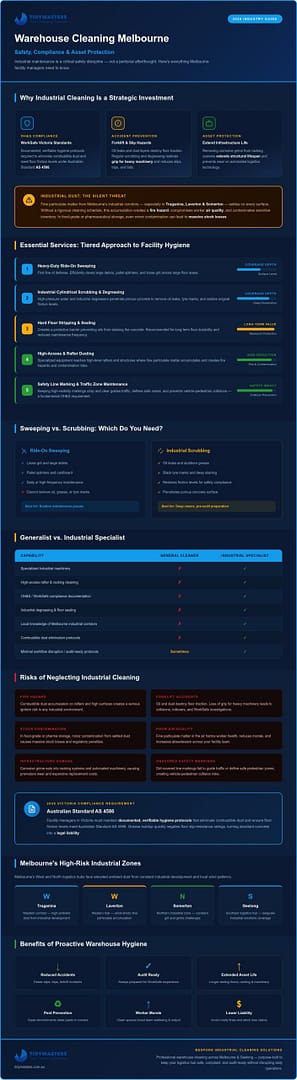
Your facility must meet specific floor slip-resistance ratings to ensure worker safety. Grease buildup quickly negates these ratings. It turns a standard concrete floor into a liability. High-visibility safety markings and line striping are equally vital. They guide traffic and define safe zones. If these lines are obscured by dirt, the risk of vehicle-pedestrian collisions increases. Keeping these markings crisp and clear is a fundamental part of your safety strategy. In 2026, OH&S cleaning compliance in Victoria requires facility managers to maintain documented, verifiable hygiene protocols that eliminate combustible dust and ensure floor friction levels meet Australian Standard AS 4586.
Essential Services: From Industrial Floor Scrubbing to High-Access Dusting
Maintaining a large-scale facility requires a tiered approach to hygiene. You can’t rely on generic methods for specialized environments. Every square meter of your warehouse serves a purpose. Our services ensure those areas remain functional and safe. From the concrete floor to the highest rafter, each surface demands a specific technical response. Professional warehouse cleaning melbourne providers use industrial-grade machinery to achieve results that standard equipment simply can’t match.
Warehouse Floor Sweeping vs. Scrubbing
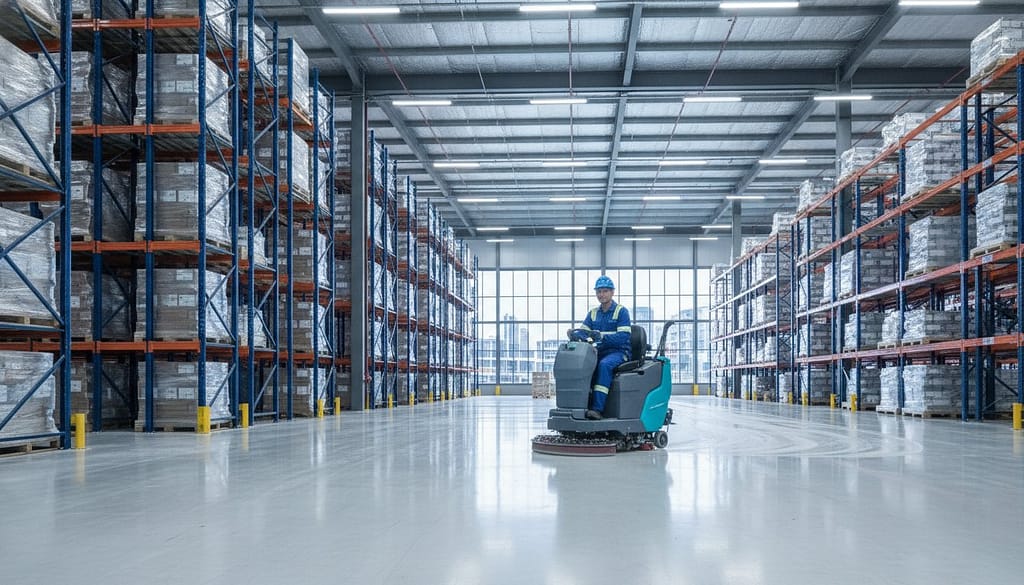
Choosing the right equipment determines the quality of your result. Heavy-duty ride-on sweepers are your first line of defense. They efficiently clear large debris, pallet splinters, and loose grit. However, sweeping only addresses surface-level mess. To remove stubborn oil leaks and black tyre marks, you need industrial scrubbing. It’s a deeper level of care that protects your floor’s integrity.
Cylindrical scrubbing machines use high-pressure water and industrial degreasers to penetrate the porous surface of the concrete. This process restores the floor’s original friction levels. For facilities looking for long-term durability, we often recommend hard floor stripping and sealing. This creates a protective barrier. It prevents oils from staining the substrate and makes daily maintenance much easier for your team.
High-Level Dusting and Rafter Cleaning
Gravity ensures that dust eventually settles on your stock, but it starts in the rafters. High-level surfaces like beams, pipes, and overhead ductwork are notorious for collecting combustible dust. This isn’t just a cleanliness issue. It’s a significant fire risk. Our teams use specialized scissor lifts and high-reach vacuum systems to clear these zones safely. We prioritize safety and precision during every high-access project.
Removing this accumulation improves your facility’s air quality. It also prevents your HVAC systems from working overtime to filter out recirculated particles. By keeping your overhead structures clear, you protect your inventory from “dust rain.” You also maintain a healthier environment for your staff. Regular warehouse cleaning melbourne schedules include these high-access points to ensure total site compliance.
Your facility’s exterior is just as important as the interior. Loading docks are high-traffic zones that accumulate grease, grime, and exhaust soot. We use high-pressure washing to strip away these contaminants, ensuring these areas stay slip-resistant. Additionally, large facilities often generate significant waste during peak seasons. We provide customized rubbish removal and site clearance to keep your external yards and internal bays clear of hazards. If you want a facility that functions perfectly, consider our industrial and warehouse cleaning solutions for a bespoke maintenance plan.
Evaluating Warehouse Cleaning Providers: Generalists vs. Specialists
Choosing the wrong cleaning partner costs you more than time. It can void your floor coating warranties, create compliance gaps, and put your team at risk. Not every commercial cleaner is equipped to handle the demands of a large-scale industrial facility. The difference between a generalist and a specialist isn’t just experience. It’s the machinery they use, the chemicals they understand, and the safety systems they operate within.
The Problem with General Commercial Cleaners
A residential or office cleaning contractor might do excellent work in a boardroom. Inside a 15,000 square metre distribution centre, they’re out of their depth. The core issues are consistent:
- Inadequate equipment: Consumer-grade scrubbers and mops can’t cover the surface area of a major logistics facility efficiently. Industrial sites require ride-on machinery, high-reach vacuum systems, and commercial pressure washers built for sustained, heavy-duty use.
- Chemical knowledge gaps: Industrial degreasers require specific dilution ratios, dwell times, and disposal protocols. Incorrect application can damage epoxy or polyurethane floor coatings, creating costly repairs and potential slip hazards.
- Safety blind spots: Working at height, handling hazardous substances, and operating near live forklift traffic demands a trained team with current safety certifications. Generalists rarely hold these credentials.
The risk of flooring damage alone should give any operations manager pause. Specialized industrial flooring represents a significant capital investment. A provider who doesn’t understand the chemistry of the substrate they’re cleaning can strip protective sealants in a single visit.
Key Questions to Ask Your Melbourne Cleaning Partner
Before signing any service agreement, ask these directly:
- Do you provide a tailored cleaning schedule that fits our shift patterns? A specialist will build a program around your operational hours, not the other way around. Disruption to your workflow is a cost you shouldn’t absorb.
- What specific machinery do you use for high-traffic loading zones? Loading docks require pressure washing and targeted degreasing. A vague answer here signals a generalist approach.
- How do you document safety protocols and audit readiness? Your provider should supply written records, not verbal assurances. WorkSafe Victoria inspections require documented evidence of your hygiene program.
It’s also worth confirming their credentials. Public liability insurance, police-checked staff, and current safety certifications aren’t optional extras. They’re baseline requirements for any reputable warehouse cleaning Melbourne provider operating on a commercial site.
One area that separates true specialists from the rest is end-of-lease or “make good” cleaning. Vacating a large industrial tenancy requires deep cleaning that meets the exact standard your lease agreement specifies. A generalist won’t know how to interpret those requirements. A specialist will. Tidy Masters has been delivering bespoke industrial maintenance across Melbourne and Geelong since 2009, with the equipment and expertise to handle facilities of any scale without cutting corners.
Planning Your Facility Maintenance: Frequency and Preparation
A reactive approach to industrial hygiene is expensive. When you’re scrambling to clean up after an audit notice or a spill incident, you’re already behind. A structured maintenance plan removes that pressure entirely. It replaces crisis management with predictable, budgeted upkeep that keeps your facility audit-ready every single day.
The right cleaning frequency depends on three factors: your industry type, your daily foot and forklift traffic, and your storage requirements. A cold-chain food distribution centre in Truganina has very different needs to a general merchandise warehouse in Somerton. There’s no universal schedule. A specialist in warehouse cleaning Melbourne will assess your specific environment and build a program that reflects your actual operational rhythm, not a generic template.
Daily Maintenance vs. Quarterly Deep Cleans
Think of your maintenance plan in two distinct layers. Daily tasks form the foundation. They prevent hazards from compounding.
- Daily: Spill management and immediate containment, high-traffic floor sweeping in loading bays and dispatch zones, and waste bin clearance to prevent pest attraction.
- Quarterly: High-level dusting of rafters and overhead ductwork, window washing to maintain natural light levels, pressure cleaning of loading docks and external hardstands, and full industrial floor scrubbing to restore friction ratings.
Your administrative and breakroom areas sit alongside these industrial tasks but require a different approach. Steam cleaning is particularly effective for staff kitchens and lunchrooms, cutting through grease and eliminating bacteria without harsh chemical residues. For the office component of your facility, the principles outlined in our Melbourne office cleaning guide apply directly to those spaces.
Scheduled maintenance also delivers a financial advantage. Regular upkeep reduces the intensity, and therefore the cost, of each quarterly deep clean. Facilities that run daily hygiene protocols consistently find that their major cleans require less time on-site, which means less disruption to workflow.
Preparation Checklist for Your Industrial Clean
Preparation determines how effective your deep clean will be. Before your service team arrives, work through these steps:
- Communicate with your team: Brief staff on cleaning zones, scheduled access times, and safety cone placement so forklift operators and pedestrians know which aisles are temporarily offline.
- Clear floor areas: Relocate pallets, loose stock, and portable racking from zones scheduled for machine scrubbing. Equipment access is non-negotiable for ride-on machinery.
- Secure sensitive assets: Cover or relocate electronics, automation control panels, and moisture-sensitive stock before pressure washing or steam cleaning begins.
- Identify hazard zones: Flag any recent oil spills or chemical residues so the cleaning team can apply the correct degreasers and dwell times from the outset.
This preparation isn’t just about efficiency. It’s about safety. A well-briefed site runs a cleaner operation with zero surprises. Contact Tidy Masters to build a bespoke maintenance schedule that fits your shift patterns and keeps your facility performing at its best.
Tidy Masters: Bespoke Industrial Cleaning Solutions for Melbourne
Tidy Masters has been working inside Melbourne’s industrial sector since 2009. That’s over fifteen years of understanding what a high-volume facility actually demands. We don’t arrive with a generic checklist. We arrive with specialized equipment, a trained team, and a maintenance plan built specifically around your site. Every warehouse is different. Your cleaning solution should be too.
Our approach is proactive, not reactive. We identify risk areas before they become compliance issues. We schedule work around your operations, not ours. The result is a facility that stays audit-ready, day in and day out, without interrupting your workflow. That’s the standard we hold ourselves to across every site we service, from Melbourne Metro to Geelong.
Serving Melbourne’s Industrial Hubs
Local knowledge shapes better outcomes. Facilities in Truganina, Altona, and Dandenong each carry distinct environmental pressures. Coastal proximity in Altona introduces salt-laden air that accelerates surface corrosion. Truganina’s rapid industrial development generates persistent fine dust that settles on racking and overhead structures faster than in established zones. Dandenong’s dense logistics corridor means higher forklift traffic and greater floor wear.
We understand these variables because we work in these suburbs regularly. Our scheduling is built to accommodate the realities of 24/7 distribution centres and shift-based operations. Confirm your site’s specific access windows with our team, and we’ll structure a program that fits without friction.
The Tidy Masters Difference: Professionalism and Relief
We’re a silent achiever. You won’t notice us disrupting your operation. You will notice the results. Floors restored to their original friction ratings. Rafters cleared of combustible dust. Loading docks pressure washed and ready for the next shift. Our full-service capability covers everything from hard floor stripping and sealing to pressure washing, window cleaning, and rubbish removal, giving you a single reliable partner rather than a roster of disconnected contractors.
Our staff are police-checked and trained in site safety protocols. We carry public liability insurance. We provide documented service records that support your WorkSafe Victoria compliance requirements. There are no verbal assurances here, only written evidence your facility was maintained to a verifiable standard.
For operations managers who are tired of chasing maintenance providers and second-guessing compliance gaps, we remove that burden entirely. You focus on logistics. We handle the rest.
- Coverage: Melbourne Metro and Geelong
- Established: 2009
- Services: Industrial floor scrubbing, pressure washing, high-level dusting, hard floor stripping and sealing, rubbish removal, and more
- Approach: Bespoke schedules built around your operational hours
Your facility deserves a warehouse cleaning Melbourne partner who treats maintenance as a strategic function, not a box to tick. Request a tailored warehouse cleaning quote today and discover what a properly maintained facility feels like.
Your Facility Deserves Better Than a Generic Clean
A safe, compliant warehouse doesn’t happen by accident. It’s the result of structured maintenance, the right equipment, and a cleaning partner who understands your environment. Throughout this guide, you’ve seen how the right approach to warehouse cleaning Melbourne protects your workers, preserves your floor coatings, and keeps your facility audit-ready without disrupting daily operations.
Three points are worth carrying forward. First, industrial hygiene is a safety investment, not an overhead cost. Second, specialists consistently outperform generalists when it comes to protecting your assets and meeting OH&S requirements. Third, a proactive maintenance schedule always costs less than reactive crisis cleaning.
Tidy Masters has been trusted by Melbourne businesses since 2009. We’re fully insured, OH&S compliant, and equipped to handle facilities of any scale across Melbourne Metro and Geelong.
Don’t leave your facility’s safety to chance. Get a professional warehouse cleaning quote for your Melbourne facility today and experience what a properly maintained site feels like.
Frequently Asked Questions About Warehouse Cleaning in Melbourne
How often should a warehouse be professionally cleaned in Melbourne?
Frequency depends on your industry type, traffic volume, and storage requirements. A food-grade distribution centre typically requires more intensive weekly or fortnightly maintenance, while a general merchandise facility might operate well on a monthly scrub with daily sweeping in high-traffic zones. There’s no universal answer because every site is different.
A specialist will assess your specific environment and build a schedule around your actual operational rhythm. The key principle is this: consistent routine maintenance reduces the intensity and cost of each major clean. Facilities that invest in regular upkeep spend less on reactive crisis cleaning over time.
Do you provide high-access cleaning for warehouse rafters and ceilings?
Yes. High-level surfaces including beams, overhead ductwork, and rafter structures are a core part of our industrial service offering. We use scissor lifts and high-reach vacuum systems to clear combustible dust accumulation from these zones safely and thoroughly. This isn’t optional maintenance; it’s a fire risk management requirement.
Overhead debris also recirculates through your HVAC system and settles on inventory below. Clearing these surfaces protects your stock, improves air quality for your team, and keeps your facility compliant with WorkSafe Victoria standards.
Can warehouse cleaning be done during business hours without disruption?
It can, provided the schedule is built correctly from the start. We structure our programs around your shift patterns and operational access windows, not ours. That means identifying which zones can be serviced while others remain active, and sequencing the work so forklift corridors and dispatch areas aren’t taken offline simultaneously.
Good preparation from your side makes this seamless. Briefing staff on cleaning zones, relocating pallets from scrubbing areas, and flagging hazard zones in advance eliminates surprises. A well-coordinated clean runs quietly in the background without friction to your daily workflow.
What equipment is typically used for industrial floor cleaning?
Industrial floor cleaning uses a two-stage approach. Heavy-duty ride-on sweepers clear surface debris, pallet splinters, and loose grit across large floor areas efficiently. For deeper cleaning, cylindrical scrubbing machines apply industrial-grade degreasers under high pressure to penetrate concrete pores, removing oil residue, tyre marks, and embedded grime that sweeping can’t touch.
For facilities requiring long-term floor protection, hard floor stripping and sealing follows the scrub. This process removes degraded coatings, restores the substrate, and applies a fresh sealant that resists oil penetration and simplifies ongoing daily maintenance. Consumer-grade equipment simply can’t replicate these results at warehouse scale.
Do you offer end-of-lease “make good” cleaning for Melbourne warehouses?
Yes. Vacating a large industrial tenancy requires cleaning that meets the precise standard your lease agreement specifies, and that standard is rarely straightforward to interpret. We’re experienced in delivering end-of-lease cleans that satisfy property managers and landlords, covering floors, loading docks, amenities, and all internal surfaces to the required condition.
This is an area where using a specialist matters significantly. A generalist cleaner won’t know how to read lease requirements or understand what “make good” means for an industrial tenancy. We do, and we document the work to give you a clear record for your property handover.
Are your industrial cleaning chemicals safe for food-grade storage facilities?
Food-grade and pharmaceutical storage environments require careful chemical selection, and we tailor our approach accordingly. We recommend confirming directly with our team which specific degreasers and cleaning agents will be used in your facility so the products can be matched to your storage classification and any relevant food safety requirements.
If your facility operates under specific accreditation or compliance frameworks, share those details when you contact us. We’ll build a cleaning program that works within those parameters rather than around them. Transparency about your site’s requirements from the outset ensures the right chemicals are selected before work begins.
Do you service warehouses outside of the Melbourne CBD, such as Geelong?
Our warehouse cleaning Melbourne coverage extends across Melbourne Metro and Geelong. We regularly service facilities in industrial corridors including Truganina, Altona, Dandenong, Somerton, and Laverton, as well as Geelong’s manufacturing and logistics precincts. Local knowledge of these areas shapes how we approach each site.
If your facility sits outside these areas, contact us directly to confirm coverage for your location. We’ll give you a straightforward answer rather than a vague commitment, so you know exactly what’s available before you plan your maintenance program.
What is the difference between warehouse sweeping and floor scrubbing?
Sweeping is your first line of defense. It removes loose surface debris like grit, pallet splinters, and dust efficiently across large areas. It’s fast and necessary, but it doesn’t address what’s bonded to the floor surface. Oil residue, tyre marks, and embedded grime require a different approach entirely.
Scrubbing goes deeper. Industrial scrubbing machines use pressurised water combined with degreasers to break down and extract contaminants from the porous concrete substrate. This restores your floor’s friction rating, which is a direct safety requirement under Australian Standard AS 4586. Sweeping maintains the surface; scrubbing restores it. Both have a role in a properly structured maintenance plan.