
Auto Dealership Cleaning: Melbourne Buyer’s Guide 2026
September 27, 2026
Medical Clinic Cleaning Melbourne: How to Choose the Right Provider
September 29, 2026

A factory can look spotless and still have cleaning gaps in the areas that matter most. Searching for “factory cleaning services melbourne” is a starting point, but food production cleaning needs to account for your site’s zones, equipment, contamination risks and documented procedures. A generic commercial checklist won’t show whether a provider’s scope fits your facility.
Cleaning also needs to fit around production, access controls and site requirements. Before engaging a provider, ask how they’ll handle your operating schedule, staff induction, task records and responsibility for checking completed work. Specific answers make it easier to compare proposals and identify gaps.
This checklist will help you map cleaning tasks to production areas, compare providers and agree on responsibilities, records and review processes. It also highlights requirements and credentials to verify rather than assume. Tidy Masters is Melbourne-based, operating since 2009, and lists industrial and warehouse cleaning among its services. Confirm directly whether your food production facility and requested scope are suitable.
Key Takeaways
- Map production, storage, staff and shared areas separately so the cleaning scope reflects how each part of your facility is used.
- For every task, record the area, frequency, responsible party and how completion will be checked.
- Compare factory cleaning services melbourne providers on scope, scheduling, supervision and reporting. Verify relevant experience and credentials directly.
- Share site access rules, operating hours and production constraints when requesting proposals so providers can prepare a practical scope.
- Before engaging Tidy Masters for a food production site, confirm whether the facility and requested cleaning work are within scope.
Factory cleaning services in Melbourne: define the needs of your site
Factory cleaning works best when the scope reflects how the site operates, rather than applying the same checklist to every building. Before comparing factory cleaning services melbourne providers, map the facility and note what each area needs. A production room, warehouse aisle and staff amenity have different surfaces, access conditions and cleaning priorities.
General factory cleaning covers agreed tasks in operational spaces such as warehouses, offices and amenities. Food-area cleaning must also follow the facility’s food safety plan and documented procedures, including any specified cleaning, sanitising and verification controls. Don’t assume a general industrial or warehouse service includes food production work.
Which factory areas belong in a cleaning scope?
Map production rooms, packaging areas, storage and warehouse zones, staff amenities, offices, shared access routes and external areas separately. For each area, note relevant surfaces, equipment boundaries, access restrictions and tasks excluded from routine cleaning. Ask site supervisors to identify sensitive zones and confirm which procedures and products are approved for use there.
- Production and packaging: identify work surfaces, nearby equipment, restricted areas and who is responsible for preparing them.
- Storage and shared routes: note floor surfaces, traffic patterns, access conditions and any areas that must remain clear.
- Amenities, offices and external areas: list these tasks separately so they don’t get confused with production work.
Set cleaning frequency and methods according to site conditions, materials and documented procedures. A method suitable for a sealed floor may not suit delicate equipment or another surface. Put boundaries in writing, including who prepares an area and who confirms it is ready for cleaning.
What makes food production area cleaning different?
In food production, the facility’s food safety plan and procedures should guide what gets cleaned, how it’s cleaned and what records or checks are needed. Visible cleanliness is useful, but it isn’t the same as documented verification or a hygiene control. The Hazard Analysis and Critical Control Points (HACCP) approach provides background on identifying and managing hazards, including through relevant cleaning procedures.
Before engaging a provider, confirm directly whether they accept food production work and can follow your site’s requirements. Ask about comparable facilities, staff training, insurance information and applicable credentials. Verify each claim rather than assuming it from a provider’s general industrial cleaning experience.
Tidy Masters is a Melbourne-based business operating since 2009, with industrial and warehouse cleaning listed among its services. Confirm directly whether a specific food production facility and its requirements are within scope.
Food production area cleaning checklist: assess zones, methods and controls
A useful food production cleaning checklist turns site procedures into clear, verifiable tasks. Build it with the people responsible for food safety and operations. Then define what the provider will do, what site staff will handle and how completion will be recorded. Set requirements from the facility’s documented procedures, not from a generic schedule.
How should production zones and cleaning tasks be recorded?
Use a row for each task and include the area, task, frequency, responsible party and verification method. The site should set the frequency based on its procedures and operating conditions. For example:
- Area: production floor | Task: remove residue and clean the floor | Frequency: site-defined | Responsible party: agreed cleaner or site team | Verification: specified visual check or record
- Area: work surfaces | Task: clean as directed, then follow any separate site-defined sanitising procedure | Frequency: site-defined | Responsible party: assigned role | Verification: procedure and record specified by the site
- Area: touchpoints, drains or shared equipment surroundings | Task: record the approved method and boundaries | Frequency: site-defined | Responsible party: assigned role | Verification: agreed inspection or log
Keep cleaning distinct from sanitising or disinfection. These are separate procedures where required by the facility. Document approved products, methods, dilution instructions and contact times exactly as specified in site procedures and product directions. Don’t substitute products or improvise instructions.
What evidence should a provider be ready to discuss?
Agree on task order, equipment segregation and re-entry conditions with the site team before work starts. Follow facility protocols, especially where tools or equipment must stay within designated zones. Confirm who authorises access and who verifies that an area is ready for production.
- Ask about relevant site experience, staff induction processes and applicable training records.
- Review insurance information, safe work procedures and chemical documentation before work begins.
- Request sample service records or inspection formats to see how tasks and exceptions are documented. These records support oversight but don’t, by themselves, guarantee compliance.
Check statements about regulatory duties against current FSANZ material and applicable Victorian or local requirements. A provider’s general industrial background isn’t proof of food-area capability. Buyers comparing factory cleaning services melbourne should verify food production experience, training and credentials directly. Tidy Masters lists industrial and warehouse cleaning, so confirm whether food production work is within scope. Its industrial and warehouse cleaning services can be a starting point for a site-specific discussion.
Compare Melbourne factory cleaning services against your production needs
A strong proposal makes it clear what’s included, what’s excluded and what you still need to verify. Compare providers against the same criteria, using your facility’s requirements as the benchmark. This helps keep broad claims or polished presentation from distracting you from practical details.
Comparison criteria
- Scope: Are tasks, areas, exclusions and proposed frequency clearly documented?
- Relevant experience: Can the provider describe comparable facilities and the specific work completed?
- Scheduling and access: Does the proposal explain how work fits production schedules, site access rules and induction requirements?
- Supervision and reporting: Who oversees the work, records completion and escalates missed tasks or site changes?
- Food-area capability: Confirm this directly. Request supporting references or documentation, and don’t infer capability from general factory or warehouse work.
How can you test whether a provider fits a food production site?
Ask for examples of comparable facilities, then clarify which areas and tasks the provider handled. Check how workers follow site procedures and access controls, and what they do if a production area changes or a task can’t be completed. Confirm that proposed methods and products can meet your documented requirements. Treat experience, training and specialist credentials as claims to substantiate through records or references.
How should buyers evaluate value beyond the quoted scope?
Compare the detail behind each proposal, not just its headline scope. Check exclusions, proposed frequency, supervision and how changes are approved. A low-detail offer can leave important responsibilities unclear. Ask whether window cleaning, pressure washing or hard floor stripping and sealing are included or listed separately. These are distinct services, not automatic parts of a factory cleaning scope.
Separate confirmed service categories from evidence you still need. Tidy Masters lists industrial and warehouse cleaning across Melbourne and Geelong. That identifies a relevant service category, but doesn’t establish food production expertise or credentials. Confirm whether your facility and requirements are within scope, and ask for relevant supporting information before deciding.
For broader service terminology and planning considerations, see the commercial cleaning FAQ guide. Use the same written criteria to assess each proposal for factory cleaning services melbourne, then shortlist providers whose documented scope fits your production needs.
Prepare a Melbourne factory cleaning checklist before requesting proposals
A clear brief helps providers quote the same job and makes gaps easier to identify. Before approaching factory cleaning services melbourne providers, gather the site details, operational constraints and responsibilities they’ll need to prepare a realistic scope.
What should a factory site walkthrough cover?
Walk each proposed area with a site contact. Note access limits, relevant surfaces, equipment boundaries, safety requirements and timing constraints. Record questions that need technical, food safety or regulatory confirmation instead of asking a provider to make assumptions. Share the same walkthrough notes with each prospective provider so proposals can be compared consistently.
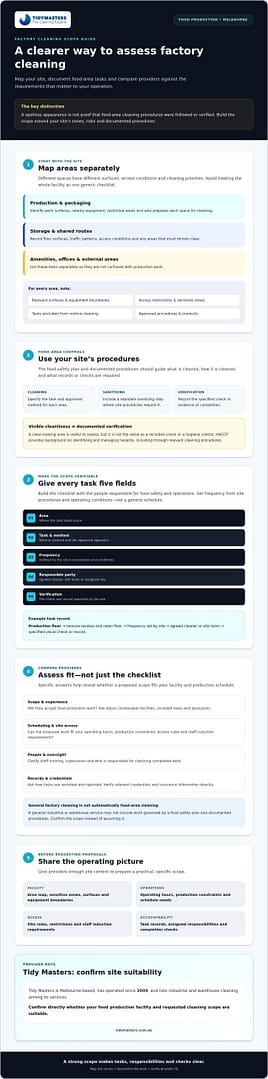
- 1. Map the facility. List each area for consideration, such as production rooms, storage, amenities, offices, access routes and external spaces. Mark restricted or sensitive zones.
- 2. Share operating details. Provide operating hours, site access rules, production constraints and the service windows available for cleaning. Explain how access or work areas may change during operations.
- 3. Assign responsibilities. Identify tasks retained by employees or specialist contractors, along with work that may be included in the cleaning scope. Clarify who prepares areas, grants access and confirms they’re ready for use.
- 4. Define each task. For every requested task, specify its location, proposed frequency, method and responsible party. Flag site procedures providers must follow, and note where technical or food safety review is still needed.
- 5. Review proposals side by side. Check each quoted scope against your brief. Record exclusions, additional services, reporting arrangements, communication contacts and the process for approving scope changes.
What should you check before approving the scope?
Make sure the proposal explains how the provider will report service issues, missed tasks and operational changes. Name the contact on both sides and agree how urgent access or scheduling questions will be raised. Check that exclusions are explicit, not buried in broad descriptions. If window cleaning, pressure washing or floor treatments are proposed, confirm whether they’re included or listed separately.
Before signing off, compare the proposal with your walkthrough notes. Every agreed task should connect to a location, frequency, method and responsible party. If food production areas are involved, confirm directly that the provider accepts that facility type and can follow its documented procedures. For wider provider-evaluation considerations, read the Melbourne cleaning company selection guide.
Have industrial and warehouse cleaning requirements to discuss? Contact Tidy Masters about your site scope, and confirm directly whether the facility and requested work are within scope.
Choose a factory cleaning partner in Melbourne with a verified scope
The right partner is one whose documented scope fits your facility, operating conditions and procedures. Compare factory cleaning services melbourne providers on what they can demonstrate, not on broad claims alone. Confirm the work areas, tasks, methods, responsibilities and reporting arrangements in writing before service begins.
Tidy Masters is a Melbourne-based cleaning and property maintenance business operating since 2009. Industrial and warehouse cleaning is a listed service. That gives factory buyers a relevant service category to discuss, but it doesn’t establish food production experience, food safety credentials or suitability for a particular site. Confirm those points directly, and request references or documentation where relevant.
What can Melbourne businesses discuss with Tidy Masters?
Share your facility type, site locations, operating schedule and requested cleaning tasks. Explain access conditions, production constraints and any documented procedures the provider would need to follow. If the scope includes food production areas, ask directly whether that work is suitable and verify relevant experience, staff training or credentials before engagement. A discussion helps establish fit, but it isn’t confirmation until the scope is agreed.
What are the next steps after choosing a provider?
Before work starts, agree on site access, induction requirements, the documented scope and named review contacts. Clarify how staff will report completed tasks, raise issues and respond when production conditions or cleaning needs change. Keep site responsibilities distinct from provider responsibilities so both parties have a clear reference point.
Set a review date after service begins. Check whether tasks, frequencies and service windows still match the way the facility operates. If requirements change, document and approve scope updates rather than relying on informal assumptions. Review relevant records and unresolved issues with the agreed contacts.
A site discussion is a practical first step for Melbourne businesses assessing service fit. Discuss your Melbourne factory cleaning requirements.
Move forward with a clear, site-specific cleaning scope
The right provider is one whose documented tasks, methods and responsibilities match your facility and operating procedures. Use your checklist to compare factory cleaning services melbourne, clarify exclusions and reporting, and verify food production experience, training and credentials before engagement. A general industrial or warehouse service alone doesn’t confirm suitability for food areas.
Tidy Masters is a Melbourne-based cleaning and property maintenance business operating since 2009. Industrial and warehouse cleaning is a listed service, with coverage across Melbourne and Geelong. If you’re considering the team, discuss your facility type, operating schedule, locations and requested tasks. Confirm directly whether the specific food production scope is suitable.
A clear conversation can establish next steps, including site access, inductions, agreed responsibilities and review contacts. Discuss your Melbourne factory cleaning requirements and explore whether the proposed scope aligns with your site. Agree on the details before treating the service as a fit.
Frequently Asked Questions
How do I choose factory cleaning services in Melbourne?
Start by mapping your facility and listing areas, tasks, operating hours and access rules. Use the same brief to compare factory cleaning services melbourne providers on relevant industrial experience, detailed scope, supervision and service records. Check exclusions as carefully as included tasks. If food production areas are involved, ask about comparable work, staff induction and how proposed methods fit your documented procedures. Verify claimed credentials before deciding.
What should a food production area cleaning checklist include?
A useful checklist records each zone, surface or task, its approved method and site-defined frequency, the responsible person and how completion will be checked. It should reflect the facility’s food safety plan and operating procedures. Include access restrictions, approved products, equipment handling and escalation steps where relevant. A generic template can help organise information, but it doesn’t establish that a site meets applicable requirements.
Can a general factory cleaner clean food production areas?
Possibly, but a general industrial cleaning service alone doesn’t confirm food-area experience or suitability. Ask for examples of comparable work and clarify which tasks the provider completed. Check how staff follow site procedures and access rules, and ask what training or records they can demonstrate. Assess proposed methods against your facility’s documented requirements. Seek guidance from the relevant authority if you need help interpreting regulatory requirements.
How often should a food production facility be cleaned?
There’s no single cleaning frequency that suits every food production facility. The schedule depends on the processes, areas, surfaces, operating conditions and site-specific procedures. Ask the facility’s responsible food safety personnel to set or approve frequencies, then record them in the service scope. Review the schedule if operations, equipment or risk assessments change. Avoid relying on a universal interval that may not reflect your site’s needs.
What should a factory cleaning services proposal include?
A clear proposal should set out each area, task, agreed frequency, service window, method and exclusion. It should also name supervision and communication contacts, explain site access requirements, and show how completed work and service issues will be recorded. For food production areas, confirm relevant experience and alignment with site procedures. Before approving the scope, check insurance information and supporting documents, and resolve unclear responsibilities.
Do Melbourne food production cleaners need specific certification?
Don’t assume one credential applies to every cleaning provider or facility. Requirements can depend on the site, the work performed and applicable rules. Ask your facility’s food safety lead which qualifications, inductions or records are relevant, then verify details against current FSANZ material and with the appropriate Victorian or local authority. Check provider claims directly and request supporting documentation before relying on credentials or experience.
Does Tidy Masters provide food production area cleaning in Melbourne?
Tidy Masters lists industrial and warehouse cleaning among its services, but food production area cleaning and related specialist credentials aren’t confirmed in the available business information. Contact the team with your facility type, requested tasks and site procedures, and ask whether the specific scope is suitable. Before deciding, verify relevant food-industry experience, staff training and supporting documentation. A listed industrial service should not be treated as proof of food-area capability.