
How to Maintain a Clean Office Environment: The Ultimate 2026 Checklist
September 19, 2026
Did you know that WorkSafe Victoria issued over $17.39 million in penalties last year? For Melbourne facility managers, a single oversight during maintenance can lead to devastating fines or a workplace tragedy. Implementing rigorous industrial cleaning safety procedures isn’t just about ticking a box. It’s about protecting your team and your bottom line. You need a strategy that balances high-standard commercial rigor with the fast-paced demands of your production schedule.
We know that keeping up with Victorian safety standards is a constant challenge. You deserve a clean, compliant site without the stress of managing downtime or liability risks. This guide provides the essential 2026 checklist to help you master the protocols required for risk-free industrial cleaning in Melbourne. We’ll walk through the latest OHS regulations, GHS 7 chemical standards, and mandatory machinery lockout procedures. By the end, you’ll have a clear path to achieving zero-incident cleaning cycles while maintaining full compliance with WorkSafe Victoria.
Key Takeaways
- Learn how to align your facility with the latest 2026 Victorian OHS Act requirements to ensure complete regulatory compliance.
- Master the essential industrial cleaning safety procedures for conducting site-specific risk assessments and high-impact Job Safety Environmental Analyses (JSEA).
- Discover the “Three-Point Check” system for chemical management to eliminate cross-contamination and maintain GHS 7 standards.
- Implement fail-safe Lock-out/Tag-out (LOTO) protocols and height safety measures to protect your team during complex machinery and warehouse cleans.
- Understand how a bespoke safety plan from a local Melbourne partner can minimize production downtime while maintaining a zero-incident environment.
Essential Industrial Cleaning Safety Standards in Victoria
Industrial cleaning safety is a systematic approach to hazard mitigation. It goes beyond basic tidiness; it’s a disciplined framework designed to protect lives and assets in high-risk environments. While standard office cleaning focuses on aesthetics, industrial cleaning safety procedures prioritize the mitigation of critical hazards like chemical exposure, machinery entanglement, and falls from height. In a warehouse or factory, a simple spill or a layer of dust isn’t just an eyesore. It’s a potential WorkSafe Victoria incident waiting to happen.
Victoria operates under the Occupational Health and Safety Act 2004. This legislation is distinct from the model laws used in other states. It places a clear duty of care on employers and those in management of a workplace to provide a safe environment. Generic commercial cleaning standards often fail in industrial settings because they don’t account for moving forklifts, high-reach racking, or the specific demands of heavy machinery. For 2026, regulatory compliance also hinges on the strict management of Safety Data Sheets (SDS). Every chemical used on-site must align with the GHS 7 mandatory classification standard. Manufacturers must update these sheets every five years, and using an expired SDS can lead to significant compliance breaches.
WorkSafe Victoria Compliance for 2026
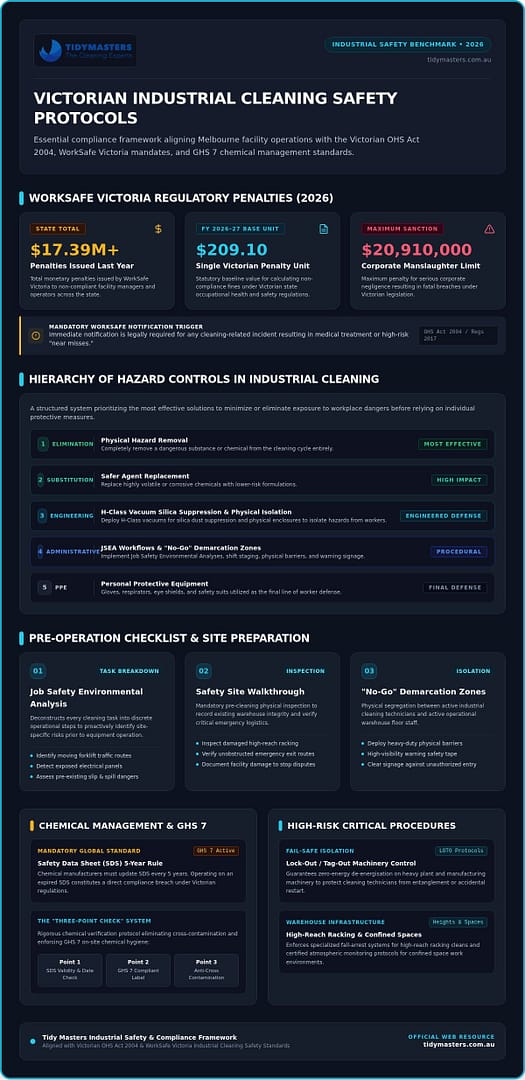
The stakes for safety in 2026 are higher than ever. For the FY 2026-27 period, the value of a single Victorian penalty unit has risen to $209.10. Serious breaches can lead to corporate manslaughter penalties of up to $20,910,000. These figures reflect the state’s rigorous approach to workplace protection. Mandatory reporting requirements now demand immediate notification for any cleaning-related incident that results in medical treatment or high-risk “near misses.” Tidy Masters aligns with these state-level benchmarks by integrating WorkSafe reporting standards and Victorian OHS Regulations 2017 into every bespoke site plan. We act as your proactive safety partner, ensuring your facility remains a zero-incident zone.
The Hierarchy of Hazard Control
Effective risk management follows a specific hierarchy of hazard controls to ensure maximum protection. We always aim to eliminate the hazard first, such as removing a dangerous substance entirely. If elimination isn’t possible, we move to substitution or engineering controls like using H-Class vacuums for silica dust suppression. Administrative controls and Personal Protective Equipment (PPE) serve as the final lines of defense. We don’t just hand out gloves and hope for the best; we build processes that reduce the need for PPE by making the environment inherently safer. The hierarchy of hazard controls is a structured system used to minimize or eliminate exposure to workplace dangers by prioritizing the most effective solutions first.
Pre-Operation Checklist: Risk Assessment and Site Preparation
Safety starts long before the first high-pressure hose is turned on. In a busy Melbourne warehouse, the environment is constantly shifting. This makes a Job Safety Environmental Analysis (JSEA) the most critical tool in your arsenal. A JSEA allows our team to break down every task into logical steps to identify potential hazards. We look for high-risk elements such as moving forklifts, exposed electrical panels, and existing spill risks that could lead to slips. By following these industrial cleaning safety procedures, we ensure that every technician understands the specific dangers of your site before they begin work.
Effective site preparation also relies on clear communication between our cleaners and your floor staff. We establish “No-Go” zones using physical barriers, safety tape, and clear signage to prevent unauthorized entry into active cleaning areas. This separation is vital for maintaining a zero-incident environment. These steps align with the WorkSafe Victoria cleaning safety guidelines, which emphasize the need for coordinated risk management in shared workspaces. If you are unsure how to secure your facility for maintenance, our team can help you design a bespoke site preparation plan that fits your workflow.
The Safety Site Walkthrough
A pre-cleaning inspection is a non-negotiable step in our process. We walk the site to identify key indicators of risk, such as obstructed emergency exits or damaged racking. This walkthrough also serves a dual purpose: we document any existing damage to your facility. This prevents liability disputes and ensures total transparency. We verify that all access points are clear and that emergency exit routes remain unobstructed throughout the duration of the clean. It’s a meticulous approach that provides peace of mind for facility managers.
Tool-Box Talks and Team Briefings
We never start a shift without a 10-minute safety briefing, often called a tool-box talk. This is where the human element of safety comes to the forefront. During this time, we review the specific Industrial & Warehouse Cleaning plan for the day. Every team member must confirm they understand the emergency stop procedures for on-site machinery and the location of first aid kits. We also verify that communication channels, such as two-way radios, are functioning correctly. These briefings ensure that industrial cleaning safety procedures are not just written on a page but are actively practiced by every person on the floor. It’s this level of discipline that keeps your production lines running safely and efficiently.
Chemical Management and PPE Protocols
Managing hazardous substances is a core pillar of industrial cleaning safety procedures. In high-output environments, the use of industrial-grade solvents and degreasers is common. However, these powerful agents require strict handling to prevent chemical burns or respiratory distress. We standardize the storage of all chemicals by ensuring every container aligns with GHS 7 labelling requirements. This includes maintaining a clear register of hazardous substances where every Safety Data Sheet (SDS) is less than five years old. Failure to maintain these records doesn’t just risk safety; it risks heavy penalties during a WorkSafe audit.
To eliminate errors during preparation, our team utilizes a “Three-Point Check” for chemical decanting and dilution. First, we verify the chemical identity against the site-specific task. Second, we confirm the dilution ratio using calibrated dispensing equipment. Finally, we ensure the secondary container is correctly labelled with its contents and safety warnings. This methodical approach follows the managing risks of hazardous chemicals code of practice, ensuring that no technician is exposed to unknown or improperly mixed substances. If an exposure occurs, first aid stations and eye wash kits must be immediately accessible and clearly marked within the industrial zone.
Selecting the Right PPE for Industrial Sites
Personal Protective Equipment (PPE) is your final line of defense. We select PPE based on a dual assessment of the cleaning agent and the surface type. For poorly ventilated warehouse corners or tasks involving volatile organic compounds, respiratory protection is mandatory. We don’t rely on generic solutions. Our technicians use chemical-resistant nitrile gloves for solvent handling and heavy-duty puncture-resistant options when clearing debris. During high-pressure washing, full-face shields are essential to protect against high-velocity splashback and aerosolized contaminants. This level of detail ensures that our team remains protected while delivering a high-standard finish.
Safe Chemical Storage and Disposal
Safe storage extends beyond the cleaning cupboard. Bulk cleaning liquids require secondary containment, such as bunded pallets, to catch potential leaks before they reach warehouse drains. We also strategically position spill kits near chemical storage zones. These kits must contain appropriate absorbents, neutralizers, and disposal bags to manage a leak instantly. For a broader look at how these standards apply across different sectors, you can explore our guide on Commercial Cleaning in Melbourne. Proper disposal is equally critical; we never pour industrial waste into standard sewage lines, ensuring your facility remains environmentally compliant and avoids costly EPA fines.
High-Risk Procedures: Heights, Machinery, and Confined Spaces
High-risk tasks demand more than just standard care. They require specialized industrial cleaning safety procedures to prevent catastrophic failures. Cleaning high-reach racking or warehouse ceilings involves significant fall risks. In Victoria, any risk of a fall from more than 2 metres mandates specific controls under the OHS Regulations 2017. Large-scale floor stripping and sealing also present severe slip hazards. We manage these by deploying high-traction footwear and strict exclusion zones to keep your staff away from active chemical layers. Our goal is to maintain your productivity without compromising the safety of anyone on the floor.
Entry into industrial tanks, pits, or silos is one of the most dangerous tasks in the sector. Under Victorian OHS Regulations and AS 2865-2009, these confined spaces require a formal written permit and continuous atmospheric testing for oxygen levels and toxic gases. We ensure a dedicated external standby person remains on-site at all times to monitor the safety of the technician inside. This level of rigor is why we are the preferred partner for complex facility maintenance across Melbourne and Geelong. We handle the high-risk details so you don’t have to.
Working at Heights: Scissor Lifts and Harnesses
Elevated Work Platforms (EWP) are essential for deep cleaning warehouse infrastructure. Our operators hold current high-risk work licenses and industry-recognized certifications for operating scissor lifts and booms. Every shift begins with a documented daily equipment inspection of the lift and all safety harnesses. We also implement strict drop-zone management. This involves using physical barriers and safety netting to protect ground-level workers from falling tools or debris. Safety at height is a non-negotiable priority for our team, ensuring every high-level clean is executed with precision.
Machinery Guarding and Electrical Safety
Cleaning near heavy machinery requires zero-energy isolation to prevent accidental activation. We verify that all machinery guards are securely in place before and after every cleaning cycle to prevent entanglement. Wet cleaning near high-voltage industrial equipment requires specialized non-conductive tools and strict distance protocols to avoid electrical arcing. Lock-out/Tag-out (LOTO) is the mandatory process of isolating energy sources and securing them with a physical lock and tag to ensure machinery cannot be restarted while cleaning is in progress. This protocol is essential for protecting technicians working within machinery danger zones.
If your facility includes high-risk zones that require expert care, contact Tidy Masters for a specialized industrial safety audit to secure your site.
Implementing a Safety-First Strategy with Tidy Masters
Relying on a generic cleaning vendor in a high-risk environment is a gamble you don’t need to take. Tidy Masters builds bespoke safety plans tailored to the specific layout and operational flow of Melbourne industrial sites. We don’t believe in one-size-fits-all solutions. Instead, we transition your facility from a reactive hygiene model to a proactive one. This ensures that industrial cleaning safety procedures are integrated into your daily operations, preventing hazards before they impact your production schedule.
Our team brings a deep understanding of the local Geelong and Melbourne regulatory landscape. We stay current with WorkSafe Victoria’s evolving standards so you don’t have to. This regional expertise allows us to navigate compliance hurdles with ease, providing a level of commercial rigor that faceless corporations can’t match. We take pride in being a disciplined partner that supports your success by removing the burden of maintenance and liability.
We also offer a seamless way to integrate Property Maintenance with our core cleaning services. This holistic strategy addresses everything from high-pressure washing to minor repairs, ensuring your facility remains in peak condition. By combining these services, we reduce the number of contractors on your site. This simplifies your safety management and lowers your overall liability risk. It’s a methodical approach designed for efficiency and aesthetic perfection.
Our Commitment to Victorian Safety Standards
Continuous training is the backbone of our service. Our specialized industrial teams participate in ongoing programs to master the latest industrial cleaning safety procedures and equipment. We provide transparent reporting and comprehensive safety documentation for every facility manager we serve. You’ll receive clear, declarative proof of our compliance, from JSEA logs to chemical registers. This level of accountability is why we remain the trusted choice for Melbourne’s high-stakes industrial environments.
Next Steps: Securing Your Facility
Securing your facility is a straightforward process. Start by booking a safety-focused site audit with our Melbourne team. We’ll walk your floor, identify potential pain points, and customize a cleaning schedule that minimizes operational downtime. Our goal is to work behind the scenes as a silent achiever, ensuring your environment functions perfectly without friction. Request a safety-first industrial cleaning quote today to protect your team and your bottom line.
Elevating Your Facility’s Safety Standards
Mastering industrial cleaning safety procedures is the most effective way to protect your workers and your business reputation. By implementing the 2026 checklist, you move from merely managing risks to actively eliminating them. You ensure that every high-reach clean and chemical application meets the rigorous standards set by WorkSafe Victoria. This disciplined approach doesn’t just prevent accidents; it creates a high-standard environment where your team can perform at their best without the burden of maintenance.
Choosing a proactive partner who understands the local Melbourne and Geelong landscape is essential for long-term success. You need a team that brings specialized industrial equipment and a meticulous eye for detail to every shift. Tidy Masters acts as your silent achiever, providing the commercial rigor and expert care your facility deserves. It’s time to replace the fear of liability with the confidence of a zero-incident workplace.
Get a Professional Industrial Cleaning Quote for Your Melbourne Facility and let our WorkSafe Victoria compliant team secure your site today. We’re proud to support Melbourne’s industrial success through workmanship that values health, safety, and aesthetic perfection above all else.
Frequently Asked Questions
What are the most common safety hazards in industrial cleaning?
The most frequent hazards include falls from heights exceeding 2 metres, chemical exposure from industrial solvents, and collisions with moving plant like forklifts. Slip hazards during floor stripping and sealing also remain a top cause of workplace injuries in Victoria. Our teams mitigate these risks by establishing strict exclusion zones and using non-slip footwear. Identifying these site-specific dangers during the initial walkthrough is the first step toward a zero-incident cleaning cycle.
Does WorkSafe Victoria require specific certifications for industrial cleaners?
WorkSafe Victoria mandates that any technician performing high-risk tasks, such as operating an elevated work platform (EWP) or entering a confined space, must hold a valid High-Risk Work License. Additionally, all staff must be trained in GHS 7 chemical management and Victorian OHS Act compliance. We ensure our specialized industrial teams are fully certified and up to date with the latest 2026 reporting requirements to maintain your site’s regulatory standing.
How often should a risk assessment be performed for warehouse cleaning?
A formal Job Safety Environmental Analysis (JSEA) must be conducted before every cleaning shift to account for daily changes in warehouse traffic and stock levels. You should also perform a comprehensive site audit quarterly or whenever new machinery is installed. This proactive approach ensures that industrial cleaning safety procedures remain relevant to your specific operational flow. Regular assessments prevent the complacency that often leads to avoidable workplace accidents and liability claims.
What is the difference between commercial and industrial cleaning safety procedures?
While commercial cleaning focuses on public spaces and offices, industrial cleaning safety procedures address high-risk variables like heavy machinery and hazardous chemical storage. Industrial environments require specialized protocols such as Lock-out/Tag-out (LOTO) for machinery and atmospheric testing for confined spaces. These procedures are designed to manage the commercial rigor of a production facility where a single safety oversight can lead to significant operational downtime or multi-million dollar legal penalties.
What PPE is mandatory for high-pressure washing in an industrial setting?
Technicians must wear full-face shields to protect against high-velocity splashback and aerosolized contaminants. Mandatory equipment also includes chemical-resistant gloves, waterproof suits, and steel-cap boots with high-traction soles to prevent slips on wet surfaces. Hearing protection is essential when operating high-decibel pressure equipment in enclosed warehouse spaces. We select every piece of gear based on the specific cleaning agent and the surface being treated to ensure the highest level of operator safety.
Can industrial cleaning be performed during active warehouse shifts?
Yes, industrial cleaning can be performed during active shifts if strict exclusion zones are established. We use physical barriers, safety tape, and clear signage to separate our cleaning teams from your active forklift traffic and production lines. This coordination requires clear communication between our site supervisor and your floor manager. Our goal is to act as a silent achiever, maintaining your facility’s hygiene with minimal disruption to your daily production targets.
What should be included in an industrial cleaning spill response plan?
A robust plan must include immediate access to Safety Data Sheets (SDS), neutralizing agents, and specialized absorbents suitable for the chemicals on-site. It should also outline clear containment steps to prevent liquids from entering warehouse drains or reaching sensitive machinery. Every team member must know the location of spill kits and the internal reporting line for hazardous incidents. This structured response minimizes environmental damage and ensures your facility remains compliant with Victorian EPA regulations.
How do I verify if a cleaning company follows Australian safety standards?
You should request a copy of their site-specific Safe Work Method Statements (SWMS) and proof of their $20M public liability insurance. A reputable partner will also provide documentation of their staff’s High-Risk Work Licenses and GHS 7 chemical training. Verify their experience with Victorian-specific OHS legislation rather than generic national models. At Tidy Masters, we provide transparent safety documentation to give facility managers total confidence in our disciplined, expert approach to maintenance.