
The Importance of Hygiene in Childcare Centres: A Practical Guide
September 25, 2026
Auto Dealership Cleaning: Melbourne Buyer’s Guide 2026
September 27, 2026
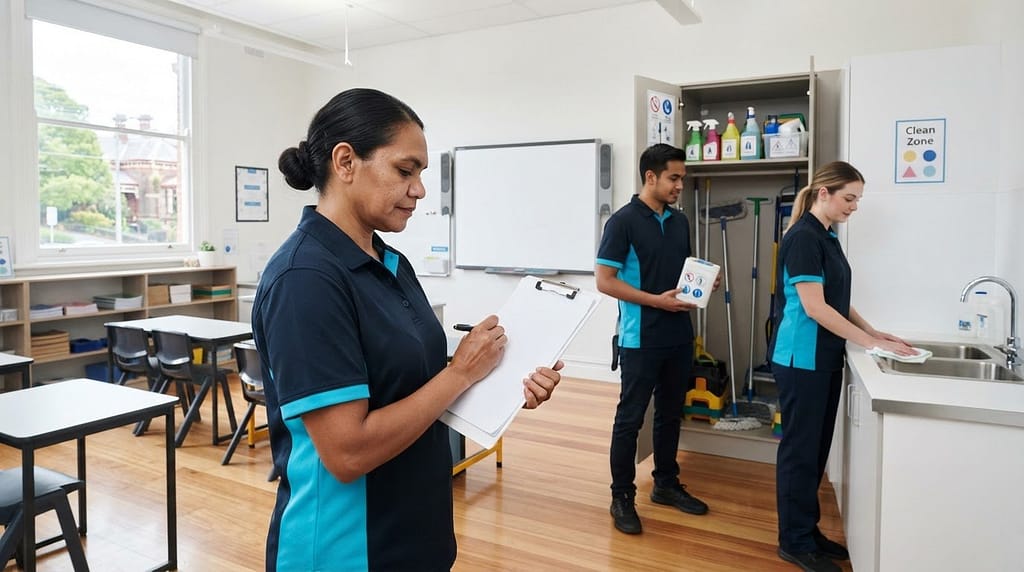
Could a spotless classroom still leave a school with questions about safety, completed work or follow-up? School cleaning compliance victoria depends on more than visible results. Clear routines, safe cleaning methods and school-specific oversight all matter.
It can be difficult to determine which requirements apply, especially when cleaning arrangements differ between metropolitan and regional government schools. Schools also need records showing what was completed, how issues were handled and how chemicals and site access are managed.
This guide offers a practical framework for planning and reviewing school cleaning in Victoria. It covers what to clarify in the cleaning scope, what to document and how to assess a provider’s approach, without treating general guidance as a universal legal standard.
It also looks at relevant Department of Education policies, differences between metropolitan and regional arrangements, and questions that can support safer, more accountable cleaning. Clear expectations and reliable records help schools oversee cleaning and respond to concerns promptly.
Key Takeaways
- School cleaning compliance victoria depends on a school’s setting, activities, current policies and agreed cleaning arrangements.
- Turn site requirements into clear schedules that distinguish routine, periodic and incident-led tasks.
- Check product labels, Safety Data Sheets and storage arrangements, then record any follow-up needed.
- Use a consistent review cycle: inspect work, document findings, assign actions and confirm they’re complete.
- Compare providers by their proposed scope, site induction, communication and approach to documented quality reviews.
What does school cleaning compliance in Victoria involve?
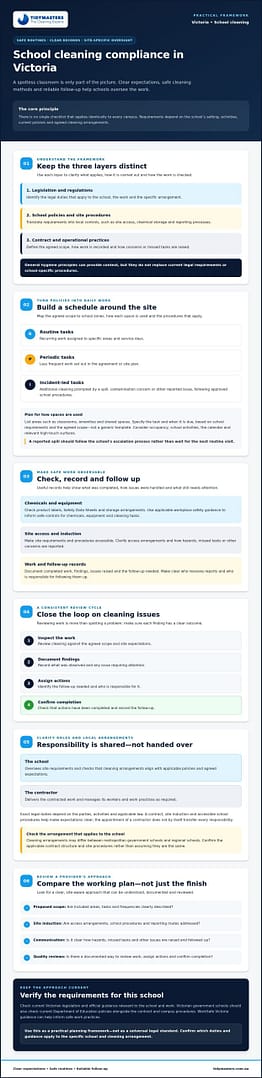
In practical terms, school cleaning compliance means meeting the legal duties that apply to a site, following relevant policies and carrying out the procedures agreed for that school. It isn’t a single checklist that applies identically to every campus. Requirements can depend on the school type, activities, cleaning contract and current official guidance.
Keep three layers distinct. Legislation and regulations set applicable legal duties. School policies and site procedures translate requirements into local controls, such as access arrangements and chemical storage rules. Contract terms and operational practices define the agreed work, how it should be recorded and how issues are raised. General hygiene principles provide useful context, but don’t replace current legal or school-specific requirements.
Which requirements may affect school cleaning in Victoria?
Start with current Victorian legislation and official guidance relevant to the school and the work. WorkSafe Victoria guidance can help inform workplace health and safety controls, including those for chemicals, equipment and cleaning tasks. Confirm which duties and guidance apply to the specific arrangement instead of treating general advice as a universal rule.
For Victorian government schools, check current Department of Education policies alongside the contract and campus procedures. The Department’s Cleaning Policy was updated on 13 March 2026, and its Chemical Management policy on 28 July 2026. Verify the current versions before relying on them. If Child Safe Standards or school safeguarding policies are relevant, clarify access controls, reporting processes and any screening responsibilities using current official guidance.
Who is responsible for school cleaning compliance?
Responsibility is shared through distinct roles. It doesn’t transfer simply because a contractor has been appointed. The school oversees its site requirements and checks that cleaning arrangements align with applicable policies and agreed expectations. The contractor is accountable for delivering the contracted work and managing its workers and work practices as required. Exact legal duties depend on the parties, activities and applicable law, so confirm them rather than assuming the contract covers everything.
A clear contract, site induction and accessible school procedures help turn broad expectations into consistent daily work. They should identify the areas included, explain site access, show how hazards or missed tasks are reported, and name who receives and follows up reports. Arrangements may differ between metropolitan government schools and regional schools, so check the applicable contract structure.
For practical school cleaning compliance victoria, keep the school’s requirements, the provider’s agreed scope and current official guidance aligned. A school can discuss its site needs with a local provider, document expectations and review whether the arrangement is working. This is general information, not legal advice.
How Victorian schools can turn policies into safe cleaning routines
Policies are useful when staff can follow them consistently on site. Start by mapping the agreed cleaning scope to the school’s zones, how those spaces are used and the procedures that apply. A classroom, shared corridor and amenities block may need different tasks because occupancy, surfaces and access conditions differ.
Then divide the schedule into three categories:
- Routine tasks: recurring work assigned to specific areas and service days.
- Periodic tasks: less frequent work set out in the agreement or site plan.
- Incident-led tasks: additional cleaning prompted by a spill, contamination concern or other reported issue, following the school’s approved procedures.
Set frequencies according to the school’s requirements and agreed service scope, not a generic template. Match the schedule to the school calendar and expected use. For example, a room used for an event may need a different arrangement from a closed space. A reported spill should follow the school’s escalation process rather than wait for the next routine visit.
How should a school cleaning schedule be structured?
Organise tasks by area, frequency and agreed scope. List classrooms, amenities, shared areas and relevant high-touch surfaces, then specify the task and when it is due. Check that the schedule reflects occupancy, school activities and approved cleaning procedures. WorkSafe Victoria’s cleaning safety guidelines can help inform safe work practices. Confirm which guidance applies to the site and tasks.
A schedule says what should happen. A completion record shows what was done, when and what needs follow-up. Keep both current so the school can identify missed tasks and resolve issues without relying on memory.
How do child safety and access procedures fit in?
Before work begins, brief cleaning staff on the site’s access arrangements, restricted areas and reporting contacts. Where school procedures require it, explain sign-in steps, how keys or access devices are handled, and whom to contact if a room is occupied or an unexpected hazard is found. Make sure the provider knows how to escalate an incident promptly.
Child safety arrangements must reflect the school’s policies and applicable requirements. Verify current Child Safe Standards guidance and responsibilities before making compliance claims. An induction should explain local expectations, but it doesn’t replace checking whether staff screening or other safeguards apply to the specific setting and working hours.
These controls give school cleaning compliance victoria a day-to-day structure: clear tasks, safe access and traceable completion. Schools can discuss site requirements and cleaning scope with a local provider. Tidy Masters provides school and childcare cleaning across Melbourne and Geelong; review its school cleaning services as one option when considering a site-specific arrangement.
What should schools check about cleaning chemicals, equipment and records?
Start with evidence that helps the school compare products and work practices with its own procedures. Check the current Department of Education Chemical Management policy and relevant site requirements. The policy was updated on 28 July 2026. Verify the current version before relying on it. A chemical register or digital system can organise product information, but it doesn’t replace checking what is actually stored and used on site.
What chemical information should a school request?
Ask how staff identify each product and access its current Safety Data Sheet (SDS). An SDS helps users understand a product’s hazards, safe handling and storage instructions, recommended protective measures, first aid guidance and spill response. Compare the SDS and product label with the school’s approved procedures. Don’t assume a product is non-toxic or child-safe unless credible, product-specific evidence supports that description.
Use a simple comparison to identify gaps and assign follow-up:
| Item to check | Evidence to request | Follow-up action |
|---|---|---|
| Product identity and label | Product name, label and matching site register entry | Resolve mismatches and confirm the product is approved for use under school procedures |
| Safety Data Sheet | Current SDS accessible to relevant workers | Confirm workers know how to find and follow its instructions |
| Storage and access | On-site storage arrangements and applicable product instructions | Address any conflict with school procedures or verified requirements |
| Equipment condition | Inspection or maintenance records, where agreed | Report faults, remove unsafe equipment from use and arrange appropriate follow-up |
| Training and incidents | Relevant induction or training records and issue reports | Clarify who investigates, communicates and verifies corrective action |
Which records help schools monitor cleaning services?
Useful records may include the cleaning schedule, completed-task logs, site inductions, chemical information, equipment checks and documented issue follow-up. Agree who reviews each record, how exceptions are reported and where records are kept. Set retention arrangements according to applicable requirements and the school’s contract. Don’t assume one retention period suits every record.
Equipment checks and worker instruction matter because a sound cleaning plan depends on safe methods as well as completed tasks. Ensure staff know how to report damaged equipment, a spill or an unexpected hazard. Identify the school and provider contacts responsible for responding. These practical checks make school cleaning compliance victoria easier to oversee, with evidence to support timely decisions rather than unsupported assurances.
How can Victorian schools audit cleaning and fix compliance gaps?
A useful review checks whether cleaning matches the agreed scope, problems are handled promptly and completed actions can be verified. It doesn’t need invented pass marks or a generic checklist. Set the review approach around the site’s risks, school procedures and contract terms, then apply it consistently.
Use this practical review cycle:
- Define expectations. Confirm the agreed tasks, areas, outcomes and reporting process.
- Inspect. Observe relevant spaces and compare their condition with the scope and site procedures.
- Record findings. Note the date, location, issue and supporting evidence, such as a task log or observation.
- Assign action. Name the person responsible and agree a follow-up date with the relevant school contact or provider.
- Verify closure. Check that the action was completed and record the outcome. Reopen the issue if it remains unresolved.
Inspection frequency should reflect site activities, the risk profile and agreed contract terms. A school might review a heavily used area differently from a space with limited use, but the appropriate frequency should be set locally, not treated as a universal requirement. Review the approach if occupancy, school activities or service scope changes.
What should a school cleaning inspection cover?
Compare observable results with the cleaning scope and relevant site procedures. If an amenities area appears to have been missed, check the applicable schedule and completion record before deciding what happened. Give each finding an owner, a proposed action and a follow-up date so it doesn’t disappear into informal conversations.
Keep records consistent and factual. Include relevant details such as location, task and status, while following school rules on student privacy, photography and access. An inspection record should support resolution without capturing unnecessary personal information.
How should a school respond to a missed task or incident?
Follow the school’s incident and escalation procedures, especially for urgent hazards. Record what was reported, when it happened, who was notified, what response was taken and whether corrective action remains outstanding. Don’t wait for a routine review if school procedures require immediate escalation.
If the same issue recurs, review it with the school contact and provider. Look for practical causes, such as an unclear scope, a schedule that doesn’t reflect room use, missed communication or a training need. Agree an adjustment and check whether it resolves the pattern. This evidence-led approach keeps school cleaning compliance victoria part of active oversight, rather than a paperwork exercise.
For a cleaning arrangement tailored to a school site, discuss your school cleaning requirements with Tidy Masters, which provides school and childcare cleaning across Melbourne and Geelong.
How to choose a school cleaning provider in Melbourne and Geelong
Choose based on evidence and operational fit, not broad promises of “full compliance”. A provider should explain how its proposed service matches the school’s agreed scope, site procedures and communication needs. For school cleaning compliance victoria, the school remains responsible for checking applicable requirements and overseeing its arrangements. A contractor can support that process through clear service delivery and reporting, but shouldn’t replace school oversight.
Local coverage can make site discussions and routine communication more practical. Tidy Masters is a Melbourne-based Australian business operating since 2009, with school and childcare cleaning among its services and coverage across Melbourne and Geelong. Confirm the exact service scope and arrangements needed for your campus before deciding.
What questions should schools ask prospective cleaners?
Ask each provider to explain its approach and how it would work at your site. Useful questions include:
- How will you adapt the cleaning schedule to our rooms, school calendar and agreed priorities?
- What task-completion and issue-reporting records can you provide for review?
- How are missed tasks, hazards or other concerns escalated, and who is the school’s contact?
- How will your staff be inducted on our access rules, restricted areas and reporting procedures?
- How do you review service quality with the school, and how are agreed corrective actions tracked?
Look for specific, relevant answers. A sample report or clear explanation of the review process can help decision-makers assess whether records will support effective oversight. Confirm that any proposed induction and access arrangements fit the school’s procedures.
What should a school include in its cleaning agreement?
Write down the service boundaries before work starts. Identify the locations covered, tasks, agreed frequencies, exclusions and how changes to the scope will be managed. Specify communication contacts, the information to include when reporting an issue, and how service concerns will be reviewed and followed up.
Check that the proposed arrangement fits the school’s contract requirements and current policies. Don’t rely on a guarantee of compliance. Assess whether expectations are clear, evidence can be reviewed and responsibilities for communication are understood. If requirements change, document the updated scope and share it with relevant school and provider contacts.
For a school or childcare facility in Melbourne or Geelong, discuss campus requirements and the proposed cleaning scope with Tidy Masters. A tailored conversation can help clarify the work and reporting arrangements to consider, without replacing the school’s own compliance checks.
Build a cleaning plan your school can confidently oversee
Strong school cleaning compliance victoria starts with a clear, site-specific scope, safe routines and reliable records. Keep expectations practical: distinguish legal duties from school procedures and contract details, then review completed work and follow up on gaps. Requirements vary, so check current official guidance and your school’s own arrangements rather than relying on a one-size-fits-all checklist.
A well-matched cleaning provider can support the school’s safety and oversight process. Look for a clear explanation of the proposed scope, communication approach and documented service reviews. Tidy Masters is a Melbourne-based business operating since 2009, with school and childcare cleaning among its services and coverage across Melbourne and Geelong.
If you’re reviewing an existing arrangement or planning a new one, discuss a tailored school cleaning plan with Tidy Masters. A conversation about your campus requirements is a practical next step towards an arrangement your team can monitor with confidence.
Frequently Asked Questions
Is there a single school cleaning standard for every school in Victoria?
No. Cleaning arrangements aren’t identical across every Victorian school. Applicable duties, Department of Education policies, campus procedures and contract terms all influence what’s expected. Government schools may also have different procurement arrangements: metropolitan services are centrally managed, while regional school councils enter their own cleaning agreements. Check current official guidance and the school’s specific contract before setting expectations. A generic checklist can help start a review, but it can’t replace site-specific requirements.
Who is responsible for cleaning compliance in a Victorian school?
Responsibility depends on applicable duties and the school’s arrangements. The school oversees its site requirements and checks that the cleaning service aligns with relevant policies and the agreement. The contractor is responsible for delivering the agreed service and managing its workers and work practices as applicable. Clear contacts, induction procedures and reporting steps help both parties understand their roles. Confirm responsibilities against current requirements rather than assuming a contract transfers every duty.
What records should a school keep for cleaning compliance?
Keep records that show what was expected, completed and followed up. Depending on the agreement, these may include the cleaning schedule, completed-task logs, site induction records, relevant chemical information, inspection findings and issue reports. Make sure exceptions have an owner and documented outcome. Agree who reviews the records and where they’re kept. Retention periods can depend on record type and applicable requirements, so verify them rather than applying one blanket timeframe.
Are Safety Data Sheets required for cleaning products used at school?
Requirements depend on the product and applicable chemical safety rules, so don’t assume the same rule applies to every cleaning product. Ask the provider for relevant Safety Data Sheets and confirm workers can access them when needed. An SDS helps explain a product’s hazards, safe handling and storage, protective measures, first aid and spill response. Check product labels, SDS information and school procedures together, and verify current Department of Education guidance for the site.
Do school cleaners need a Working with Children Check in Victoria?
Cleaning staff who enter a school during operating hours must have a valid Working With Children Check (WWCC). Schools should confirm this requirement against current Victorian guidance and their own access and safeguarding procedures. Clarify how the provider verifies the check and what arrangements apply to the specific site and working hours. Don’t treat this answer as a substitute for checking current official requirements.
How can a school check whether its cleaning contractor is meeting the agreed standard?
Compare observable results with the written scope, schedule and site procedures. Record the area, issue, date and evidence, then assign an action, responsible contact and follow-up date. Confirm whether the issue was resolved, and review recurring problems with the provider to identify possible gaps in scheduling, communication, training or scope. For school cleaning compliance victoria, clear records and regular review support oversight. Inspection frequency should reflect site needs and contract terms.
Can a cleaning contractor help a school prepare its cleaning procedures?
A contractor can discuss the site, clarify the proposed cleaning scope and help translate agreed tasks into a practical schedule or reporting process. The school should check that these arrangements align with its current policies, official guidance and contract requirements, then approve and maintain its own procedures. A provider’s input can support planning, but it doesn’t replace the school’s oversight or constitute legal advice. Keep responsibilities and escalation contacts clear from the outset.