

Specialist Medical Suite Cleaning: The 2026 Melbourne Buyer’s Guide
September 24, 2026
School Cleaning Compliance in Victoria: 2026 Guide
September 26, 2026
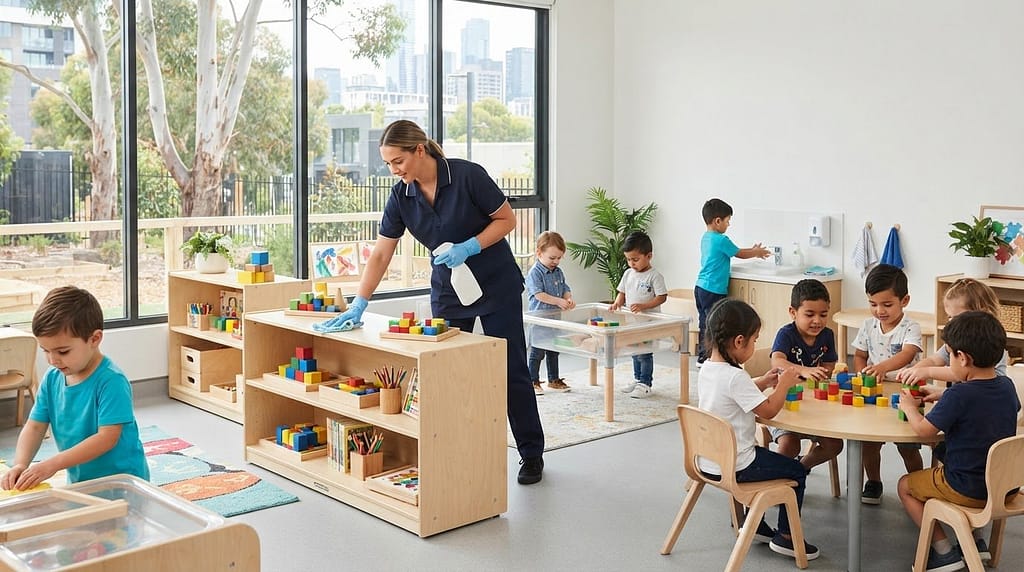
The busiest childcare spaces often need the most deliberate hygiene, not simply the most visible cleaning. The importance of hygiene in childcare centres becomes clear when children move between play areas, bathrooms, meal spaces and shared equipment, carrying germs from one surface to another. A clean environment supports children’s wellbeing, but consistent routines matter just as much as a tidy appearance.
When children, staff and shared items are in close contact, illness can spread through everyday activities. A practical response is to match cleaning attention to how each space is used. High-touch surfaces, toys, food areas and nappy-changing spaces have different needs, while staff-led hand hygiene remains essential throughout the day.
This guide explains how hygiene supports a well-maintained childcare environment and how to identify priorities across different areas of your centre. You’ll learn the difference between cleaning, sanitising and disinfecting, and how clear staff routines can work alongside a tailored professional cleaning plan. For Melbourne centres, School & Childcare Cleaning from Tidy Masters can form one part of that broader approach, not a replacement for daily hygiene practices.
Key Takeaways
- The importance of hygiene in childcare centres lies in matching everyday practices to how children use each space.
- Consider how hands, toys and shared equipment move between activities, then prioritise attention according to use and visible contamination.
- Choose between cleaning, sanitising and disinfecting based on the task, surface, product directions and current guidance.
- Make routines easier to follow by assigning responsibilities, scheduling tasks and recording what has been completed.
- When assessing Melbourne cleaning support, clarify the task scope, schedule, communication process and access arrangements before work begins.
Why the importance of hygiene in childcare centres matters
Childcare hygiene brings together cleaning, hand hygiene and appropriate disinfection to keep shared spaces cared for and everyday routines consistent. As children play, eat, explore and learn close to one another, their hands move between toys, furniture and other surfaces. Thoughtful hygiene helps reduce opportunities for germs to spread, but it cannot guarantee that children will never become ill.
Childcare hygiene is the coordinated practice of cleaning shared spaces, supporting hand hygiene and disinfecting surfaces when appropriate. This practical approach reflects the principles of infection prevention and control: consider how contact happens, then use suitable measures to help limit the spread of infection.
How hygiene supports children, educators, and families
Clean, well-maintained spaces support the daily work of a childcare centre. Children need room to play, learn and rest. Educators need an environment that is ready for changing activities, and families want to see that care is organised and consistent. Visible routines, such as cleaning up after messy play and supporting handwashing at appropriate moments, help families understand how the centre approaches hygiene without promising that illness will not occur.
Children may still become unwell when a centre takes hygiene seriously. Childhood illness is not, by itself, evidence of poor cleaning. The goal is to maintain sensible practices that support wellbeing, not to create an unrealistic expectation of a completely germ-free environment.
Why childcare settings have distinct hygiene needs
Children often sit or play close to the floor, handle toys and use shared equipment. A block used during floor play may later be picked up by another child. Tables and chairs may serve different groups throughout the day. These everyday patterns make it useful to think beyond a single end-of-day clean.
Priorities can shift with the activity. After a meal, attention may turn to eating surfaces. Following messy play, the materials and areas used may need care. Frequently handled toys and equipment may need a routine that reflects how they are shared. Not every surface needs the same treatment at the same time. Choose the task according to how an area is used and what has happened there.
For a Melbourne-specific overview of planning and service considerations, read this childcare cleaning guide for Melbourne centres. Professional School & Childcare Cleaning can support a centre’s broader approach, while staff-led hygiene routines remain essential during operating hours.
How germs can move through shared childcare spaces
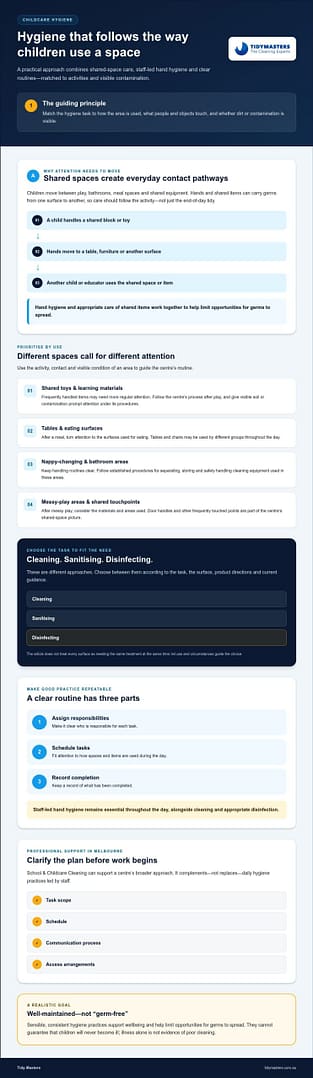
In a childcare centre, contact does not stop at the first surface. A child handles a block, touches a table, then reaches for another shared learning material. Educators also move between children, equipment and high-touch points such as door handles. These pathways explain why attention needs to follow how people and objects move through the day.
Hand hygiene and surface care work together: clean hands limit transfer, while appropriate care of shared items helps reduce opportunities for germs to spread. The NHMRC’s Staying Healthy guide offers Australian early childhood services practical guidance on preventing infectious diseases.
Shared toys, touchpoints, and play areas
Blocks, tables, door handles and shared learning materials do not all get used in the same way. A frequently handled toy may need more regular attention than an item used occasionally. Visible dirt or contamination calls for prompt action under the centre’s procedures. Set priorities according to both the surface and the activity, rather than relying on one identical routine for every area.
For a shared toy, staff can follow the centre’s process to check and clean the item as appropriate after play, then return it for use when it is ready. If the toy is visibly soiled, that changes the priority. Clear steps help prevent an item from moving straight from one activity to another without the necessary attention.
Nappy changing, bathrooms, and food areas
Nappy changing, bathroom use and food preparation involve different materials and tasks, so centres should keep handling routines clear. Follow established procedures for separating cleaning equipment used in these areas and for storing and handling it safely. This helps avoid carrying residue from one task or area into another.
Hand hygiene is a practical transition between care tasks. For example, after assisting with toileting or nappy changing, follow the centre’s handwashing procedure before moving on to food preparation or another activity. Staff should follow current centre procedures and consult the NHMRC guidance for detailed recommendations suited to early childhood settings.
Set priorities by considering who has used a space, what was handled and whether there is visible contamination. Centres reviewing their wider cleaning needs can explore Melbourne school and childcare cleaning services from Tidy Masters as one part of a broader hygiene approach. Professional cleaning can complement, but not replace, staff-led routines during the day.
Cleaning, sanitising, and disinfecting: what childcare centres need to know
Cleaning, sanitising and disinfecting describe different hygiene steps, not interchangeable tasks. Use this comparison to identify their purposes and key considerations:
- Cleaning: Removes visible soil and residue. It is used for routine care of surfaces such as tables and floors. A surface that looks clean is not necessarily hygienic.
- Sanitising: Reduces germs to a level considered safe. Use it where centre procedures or current guidance call for it, and choose a method suitable for the task and surface.
- Disinfecting: Kills most germs. It may be appropriate for particular surfaces or circumstances, but product directions and relevant guidance matter.
When routine cleaning may be enough
Routine cleaning helps remove everyday dirt from frequently used surfaces. Tables after activities and floors with visible soil are practical examples. Appearance alone cannot confirm whether a surface is hygienic, but that does not mean every surface needs disinfecting after every use. Set priorities according to how an area is used, visible contamination and the centre’s procedures.
Using disinfection thoughtfully around children
Check the product label before using a disinfectant. Confirm that it is appropriate for the surface and follow its directions. Store products safely and keep children away from them during use. For Australian early childhood guidance, consult the NHMRC’s Staying Healthy: Preventing infectious diseases in early childhood education and care services.
The importance of hygiene in childcare centres depends on choosing an appropriate method for each task, surface and circumstance. For related infection-control context, see this medical centre hygiene and safety guide. Professional cleaning can complement a centre’s approach, while staff-led routines remain essential.
How to build consistent hygiene into a childcare centre’s day
Consistency comes from a routine people understand and can follow, even as activities change. Start by identifying the centre’s priority areas, then assign responsibilities, schedule tasks and review how the plan is working. Clear ownership prevents important tasks from being assumed to belong to someone else.
Consistent hygiene depends on clear ownership and communication, not just a written schedule. Staff need to know what they are responsible for during operating hours, how to respond to unexpected mess and who to tell if a task cannot be completed or a maintenance issue needs attention.
Match hygiene routines to centre activities
Arrival, meals, toileting, rest and play create different moments to check that spaces and resources are ready for their next use. A centre-specific plan can record who handles which tasks and how spills, visible contamination or damaged surfaces should be reported. Avoid copying a generic checklist without considering your rooms, activities and routines.
Use current official childcare guidance when setting exact task frequencies and methods. The plan should make responsibilities clear without locking staff into a routine that no longer suits how a space is being used.
Coordinate staff practices and professional cleaning
Staff-led hygiene supports care throughout the operating day. Professional cleaning can address agreed tasks as part of the centre’s broader approach, but it does not replace staff responsibilities. Make the division clear: explain which areas need attention, what access arrangements apply, when cleaning can take place and how changes or concerns should be communicated.
Review the arrangement when rooms, activities or centre needs change. If a play area is repurposed or a new activity creates different cleaning priorities, update the plan and share the change with everyone involved. A simple way to report missed tasks, spills and maintenance concerns also helps centre leaders spot recurring gaps and adjust responsibilities.
For centre leaders, the importance of hygiene in childcare centres is easier to act on when expectations are practical, shared and reviewed. A tailored plan connects staff routines with agreed professional cleaning tasks, without treating either as a substitute for the other.
If you are reviewing your centre’s cleaning arrangements, discuss School & Childcare Cleaning with Tidy Masters as one part of your broader hygiene plan.
Choosing professional childcare cleaning support in Melbourne
A professional cleaning plan works best when it fits the centre’s rooms, activities and operating schedule. Centre leaders should clarify what the provider will do, how the work connects with staff-led hygiene and how both sides will keep communication clear. Tidy Masters is a Melbourne-based business that lists School & Childcare Cleaning. Confirm the current service scope and methods directly before agreeing on tasks.
Questions to ask a childcare cleaning provider
Use an initial discussion to understand how the proposed arrangement will work in your centre. Ask questions such as:
- How will you become familiar with our rooms, surfaces and centre-specific priorities?
- What tasks are included, and which remain the responsibility of our staff?
- How can the proposed schedule fit around our operating hours and activities?
- How should staff raise concerns about missed tasks, visible contamination or changing needs?
- How will we review whether agreed tasks are being completed as expected?
- Which products and methods are proposed, and are they suitable for our requirements?
Discuss the answers with centre leadership before service begins. Confirm any product or method requirements directly rather than assuming they are included. This helps avoid gaps between the centre’s expectations and the provider’s agreed scope.
Make the cleaning plan clear and centre-specific
Document the agreed task scope, timing, responsibilities, access arrangements and communication channels. Be clear about how cleaners can access relevant areas and how the centre will share changes, such as a room being used differently or a new priority emerging. Keep staff-led routines distinct from the tasks assigned to professional cleaners.
Review the plan when the centre’s use of rooms or operational needs change. A regular conversation about what is working can help keep the arrangement relevant, while a straightforward process for reporting concerns gives both sides a way to address issues.
The importance of hygiene in childcare centres is supported by routines that fit the setting and responsibilities everyone understands. For a Melbourne centre reviewing its cleaning needs, a tailored plan can complement staff practices without replacing them. To explore Tidy Masters’ cleaning services and discuss childcare cleaning in Melbourne, start with a conversation about your centre’s requirements.
Make hygiene a routine your whole team can rely on
The importance of hygiene in childcare centres is reflected in the small, consistent decisions that keep spaces cared for throughout the day. Prioritise areas according to how children use them, choose cleaning methods suited to each task and make responsibilities clear to staff and cleaning providers.
A centre-specific plan can connect everyday staff practices with professional cleaning support. Review it as rooms, activities or needs change, and keep communication open so concerns can be addressed. These practical steps support a well-maintained environment without promising that illness can always be prevented.
Tidy Masters is a Melbourne-based cleaning and property maintenance company with School & Childcare Cleaning among its listed services. If you are reviewing your centre’s cleaning needs, explore Tidy Masters’ childcare and school cleaning services and discuss the scope that may suit your setting.
Frequently Asked Questions
Why is hygiene important in childcare centres?
Good hygiene supports a clean, well-maintained environment for children to play, learn, eat and rest. The importance of hygiene in childcare centres comes from how closely children share rooms, toys and equipment throughout the day. Consistent hand hygiene and suitable care of surfaces can help reduce opportunities for germs to spread, but cannot prevent every illness. Clear routines also help educators and families understand how the centre manages everyday cleanliness.
How do germs spread in childcare settings?
Germs can move through contact between hands, people and shared objects. For example, a child may handle a toy, touch a table, then pass another item to a friend. Frequently used touchpoints, such as door handles, can also be part of these pathways. The attention needed depends on the activity, surface and visible contamination, so centres should follow procedures suited to each area rather than treat every surface identically.
What is the difference between cleaning and disinfecting in a childcare centre?
Cleaning removes dirt, soil and residue from a surface. Disinfecting is a separate process intended to kill most germs, and it is not automatically needed after every use. Sanitising is another distinct term, referring to reducing germs to a safe level. The appropriate approach depends on the task, surface, product directions and current childcare guidance. Centres can consult the NHMRC’s Staying Healthy guide when establishing suitable hygiene procedures.
How often should childcare centres clean toys and shared surfaces?
There is no single frequency that suits every toy or surface. Centres should set routines according to how often items are handled, the activities taking place, visible soil or contamination, and current official guidance. A shared toy may need attention after an activity or if it becomes visibly soiled, while other surfaces may fit into a routine schedule. Check the NHMRC’s Staying Healthy guide for practical recommendations, and document centre-specific responsibilities.
Are cleaning products safe to use around children?
Safety depends on the product, how it is used and whether its directions are followed. Centre leaders should check product labels and relevant official childcare guidance, confirm that the product and method suit the intended surface, and keep cleaning products securely stored away from children. During use, children should be kept away from products and treated surfaces as directed. Do not assume a product is suitable simply because it is labelled as a cleaner or disinfectant.
Can professional cleaning prevent illness in childcare centres?
Professional cleaning can support a centre’s broader hygiene approach, but it cannot guarantee that children will not become ill. Germs may still spread through close contact and everyday activities. Staff-led practices, including hand hygiene and responding to mess during operating hours, remain essential alongside agreed professional cleaning tasks. In Melbourne, Tidy Masters lists School & Childcare Cleaning among its services. Centres should confirm the scope and methods directly and clarify staff and provider responsibilities.
What should a childcare centre ask a cleaning company?
Ask how the proposed scope accounts for your rooms, surfaces and operating schedule, and which tasks are included or remain staff responsibilities. Confirm proposed products and methods, access arrangements, communication channels for raising concerns, and how agreed work will be reviewed. Discuss how the plan can be updated if centre needs change. Melbourne centre leaders considering Tidy Masters can explore its cleaning services and confirm current childcare service details directly.