
Retail Cleaning Melbourne: The 2026 Guide to Showroom Excellence
August 1, 2026
Floor Stripping and Sealing Melbourne: The 2026 Professional Guide to Floor Restoration
August 4, 2026
Your cleaning company didn’t show up again. No call, no explanation, just an empty building and a full day of client meetings ahead. If that scenario feels uncomfortably familiar, you’re not alone. Finding commercial cleaning companies that are genuinely reliable, not just reliable on paper, is one of the most frustrating challenges facing Melbourne facility managers in 2026.
You already know that a clean workplace isn’t just about appearances. It protects your staff, satisfies health and safety obligations, and shapes the first impression every client walks into. The problem is that too many cleaning providers deliver surface-level results, poor communication, and contracts loaded with costs you didn’t see coming.
This guide cuts through the noise. You’ll learn exactly what separates a dependable commercial cleaning partner from a company that simply owns a mop. We’ll cover what to look for in a contract, which health and compliance standards actually matter in 2026, and how the right provider can give you a truly set-and-forget facility management experience. From high-touch sanitation protocols to integrated property maintenance, here’s everything you need to make a confident, informed choice.
Key Takeaways
- Not all commercial cleaning companies deliver the same standard — knowing which certifications and compliance benchmarks to look for in 2026 will help you separate genuine professionals from underqualified operators.
- Local, privately owned providers often offer stronger accountability and consistency than national franchises, where the person who wins your contract rarely performs the work.
- A cleaning quote that looks too affordable usually means something critical is missing — understanding scope of works is the key to avoiding hidden costs and service gaps.
- Partnering with a single provider for both cleaning and property maintenance, including services like commercial painting and pressure washing, simplifies facility management and reduces the risk of things falling through the cracks.
- The right cleaning partner operates as a silent achiever in the background — so you can walk into every client meeting confident your facility is already taken care of.
Navigating the Commercial Cleaning Landscape in Melbourne
Melbourne’s commercial cleaning industry has changed significantly since 2024. Businesses that once prioritised the lowest possible quote are now asking very different questions. What infection control protocols does your team follow? How do you handle high-touch surfaces in shared workspaces? What happens if a cleaner doesn’t show up? The shift isn’t subtle. It reflects a genuine recalibration of what facility hygiene means for modern organisations.
The reasons behind this change are practical. Post-pandemic awareness of how disease spreads through shared environments has permanently raised the bar. Facility managers now understand that a visually clean space and a hygienically safe space are not the same thing. That distinction is driving businesses across Victoria toward commercial cleaning companies that can demonstrate genuine health and compliance credentials, not just a competitive hourly rate.
There’s also a compelling business case. Research consistently links workplace cleanliness to employee wellbeing, absenteeism rates, and staff retention. A poorly maintained environment signals to your team that standards don’t matter. That message has a cost, and it shows up in productivity long before it shows up on a balance sheet.
The Shift Toward Health-First Cleaning
Surface-level cleaning, wiping down desks, emptying bins, vacuuming, is table stakes now. What modern offices, medical centres, schools, and aged care facilities actually need is a proactive hygiene strategy. That means scheduled deep cleaning cycles, targeted disinfection of high-contact points like door handles, lift buttons, and shared equipment, and documented protocols that hold up to OHS scrutiny. Reactive cleaning, responding only when something looks dirty, creates gaps that put people at risk. A health-first approach closes those gaps before they become problems.
Local Melbourne Market Dynamics
Melbourne isn’t a single market. The needs of a CBD law firm operating across three floors of a Collins Street tower are fundamentally different from those of a Geelong manufacturing facility or a Dandenong childcare centre. Each environment carries its own regulatory obligations, foot traffic patterns, and hygiene risks. OHS standards under Victorian legislation apply broadly, but their practical implications vary by sector and site type.
Understanding those local nuances is what separates a genuinely capable provider from one applying a one-size-fits-all approach. For a deeper breakdown of what Melbourne businesses should be asking before signing any cleaning agreement, the Commercial Cleaning in Melbourne: The 2026 Comprehensive Business FAQ Guide covers the key questions in detail.
Tidy Masters has been operating across Melbourne and Geelong since 2009. That local tenure matters. It means understanding the specific demands of each precinct, not just the general principles of commercial cleaning.
The Essential Standards Every Professional Cleaning Company Must Meet
Credentials matter. But knowing which ones actually protect your business, versus which ones are just marketing window dressing, is where most facility managers get stuck. In 2026, a professional commercial cleaning company should be able to demonstrate clear, verifiable standards across quality management, environmental responsibility, and workplace safety. If they can’t, that’s your answer before you’ve signed anything.
The three certifications that carry genuine weight are ISO 9001, ISO 14001, and ISO 45001. Here’s what they actually mean for you:
- ISO 9001 (Quality Management): The provider has documented, audited processes for delivering consistent results. It’s not about good intentions; it’s about repeatable systems that don’t depend on who shows up that day.
- ISO 14001 (Environmental Management): The company manages its environmental impact in a structured, accountable way. This includes chemical disposal, water use, and waste reduction, not just swapping one product for a “green” label.
- ISO 45001 (Occupational Health and Safety): Staff are protected through formal safety frameworks. This matters for your site as much as theirs; an injured cleaner on your premises is your liability too.
Beyond certifications, Victorian businesses need to confirm that any provider holds adequate public liability insurance and complies with WorkCover obligations for their employees. Ask for certificates of currency, not just verbal assurances. A provider who hesitates here is telling you something important.
On environmental standards, genuine eco-friendly cleaning goes beyond product labels. It involves concentrated dosing systems that reduce chemical volume, microfibre technology that cuts water consumption, and responsible chemical disposal practices. If a company’s entire environmental pitch is “we use green products,” dig deeper.
Medical-Grade Cleaning Standards for Offices
Medical-grade cleaning isn’t reserved for hospitals. It’s a methodology built around cross-contamination prevention, and it’s directly applicable to any shared workspace. The core principle is simple: cleaning equipment, cloths, and products used in one zone should never migrate to another. Colour-coded microfibre systems, zone-specific equipment, and TGA-approved disinfectants applied at correct dwell times are the practical building blocks. HEPA filtration in vacuums prevents particulates from being redistributed into the air rather than removed from it.
Tidy Masters applies the same protocols used in medical centre cleaning to standard office environments. That’s not overcaution; it’s a recognition that the hygiene risks in a busy open-plan office aren’t categorically different from those in a clinic waiting room. High-touch surfaces, shared equipment, and dense foot traffic create the same transmission pathways regardless of the signage on the door.
Staff Training and Police Checks
A cleaning company is only as trustworthy as the people it sends to your site. For sensitive environments like schools, childcare centres, and aged care facilities, police checks aren’t optional; they’re a baseline obligation. But training matters just as much. Staff need to be certified in chemical handling, trained on site-specific safety requirements, and briefed on the particular risks of each environment they enter.
Consistency compounds this. A rotating roster of unfamiliar faces creates security risks and quality gaps. Tidy Masters prioritises long-term, stable cleaning teams for each client. The same people, who know your site, your standards, and your expectations, show up reliably. That continuity is worth more than any single credential on paper.
If you want to understand how these standards translate into a practical service agreement, speaking with the Tidy Masters team is a straightforward starting point.
Comparing Local Experts vs. National Cleaning Franchises
Here’s a pattern that plays out constantly across Melbourne. A national cleaning franchise sends a polished salesperson to your site. The pitch is compelling, the brochure is glossy, and the contract looks comprehensive. Then the actual cleaning starts, and the person who walked your facility and promised consistent standards is nowhere to be seen. A rotating cast of subcontractors arrives instead, some trained, some not, none of them accountable to anyone you can actually reach.
This is the franchise trap. National commercial cleaning companies often operate by selling territories to franchisees, who then manage their own labour, often at the lowest possible cost. The result is a structural accountability gap between the brand that won your business and the people doing the work. When something goes wrong, which it will, you’re left chasing a national help desk that has no real authority over the franchisee responsible for your site.
The local owner-operator model solves this at the root. When a privately owned business like Tidy Masters takes on a client, the people managing the contract are the same people invested in delivering it. There’s no franchise layer, no subcontracting chain, no diffusion of responsibility. That direct ownership of outcomes changes everything, from how quickly problems are resolved to how consistently standards are maintained.
Emergency response is where this difference becomes most visible. A burst pipe, a post-event clean-up, an unexpected spill before a board meeting: local providers can mobilise quickly because decisions don’t need to travel up a corporate chain. Proximity and accountability work together.
Direct Communication vs. Call Centres
Calling a national help desk to report a missed bin is a particular kind of frustration. You log a ticket, wait for a response, and then wait again while the message filters down to someone who may or may not act on it. Tidy Masters operates differently. Every client has a direct line to management, not a queue. If something needs attention, it gets addressed by someone who knows your site, your preferences, and your standards personally. That’s not a small thing. It’s the difference between a vendor and a partner.
Customisation and Flexibility
National franchises typically offer tiered packages. You choose from column A or column B, and your facility adapts to their structure. That approach fails most businesses, because no two sites have identical needs. A childcare centre requires specific compliance-driven protocols that look nothing like a corporate office clean. An industrial warehouse has different surface types, hazard zones, and scheduling constraints than a retail showroom.
Tidy Masters builds schedules around how your business actually operates, whether that means after-hours cleaning to avoid disrupting staff, day cleaning for sites that need continuous presentation, or specialised protocols for environments like childcare cleaning where regulatory compliance isn’t negotiable. The service fits your site. Not the other way around.
How to Evaluate a Commercial Cleaning Contract
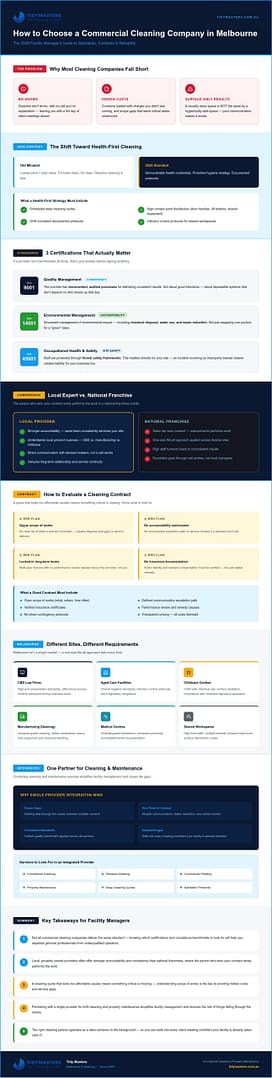
A cleaning quote is not a cleaning contract. That distinction matters more than most facility managers realise until they’re already locked into an agreement that doesn’t deliver what the original conversation promised. Before you sign anything, you need to understand exactly what you’re buying, what’s excluded, and how performance will be measured once the honeymoon period ends.
The most common trap is the low-ball quote. A price that significantly undercuts every other submission isn’t a bargain; it’s a signal. Either the scope has been quietly trimmed, the labour costs don’t reflect award wage compliance, or the consumables, toilet paper, hand soap, bin liners, are billed separately on top. Any of these scenarios turns your “affordable” contract into an expensive one within the first quarter.
When reviewing a scope of works, ask specifically what is included in the daily rate. Common exclusions that catch businesses off guard include:
- Consumables: Paper products, soap, and sanitiser are frequently excluded from base pricing and invoiced separately at inflated margins.
- Equipment wear and replacement: Some providers charge back for machine servicing or consumable parts like vacuum bags and mop heads.
- Periodic tasks: High-level dusting, window cleaning, and hard floor maintenance often sit outside the standard scope entirely.
- After-hours or weekend access fees: If your site requires cleaning outside standard hours, confirm whether a surcharge applies before assuming it’s covered.
KPIs and site audits are equally non-negotiable. A contract without measurable performance standards is just a schedule. Insist on documented quality benchmarks, agreed audit frequency, and a clear process for raising and resolving deficiencies. If a provider can’t articulate how they measure their own performance, that tells you everything.
Vetting the Quoting Process
A site walkthrough isn’t optional. Any commercial cleaning company quoting without physically inspecting your premises is guessing. Room configurations, floor surface types, foot traffic patterns, and access requirements all affect the labour and equipment needed to clean your facility properly. A walkthrough also gives you the chance to ask about the cleaner-to-supervisor ratio, a practical indicator of how closely work is monitored. For specialised environments, ask directly how the provider approaches office cleaning in Melbourne and whether their team has site-specific training for tasks like hard floor care or post-construction cleans.
The Role of Technology in Accountability
Digital logbooks and GPS-verified check-ins remove ambiguity from service delivery. Rather than taking a provider’s word that a clean was completed to specification, you have a timestamped, location-confirmed record. Tidy Masters uses proactive reporting as a standard part of its service, meaning if a cleaner identifies a maintenance issue during a visit, such as a leaking tap or a damaged fixture, it gets flagged immediately rather than left for someone else to discover. That kind of proactive communication is what separates a genuine facility partner from a company that simply cleans and leaves.
If you want to see how a well-structured cleaning agreement should read in practice, speak with the Tidy Masters team before committing to any contract.
Tidy Masters: Your Integrated Partner for Cleaning and Maintenance
Most commercial cleaning companies stop at the mop. They clean your floors, empty your bins, and leave. What they don’t do is notice that your building’s facade is stained with years of grime, that your hard floors are losing their finish, or that your interior walls need a refresh before your next major client visit. Tidy Masters does all of it. That’s not a minor distinction; it’s the difference between a cleaning vendor and a genuine facility partner.
Managing multiple contractors is its own full-time job. Separate providers for cleaning, painting, and pressure washing means separate quotes, separate schedules, separate points of contact, and separate accountability gaps when something doesn’t get done. A single integrated partner removes that complexity entirely. One relationship. One standard. One team that knows your facility inside and out.
Integrated Property Maintenance Services
Routine cleaning keeps your facility presentable day to day. Periodic deep cleaning protects it at a structural level. Tidy Masters combines both through services like steam cleaning in Melbourne, which penetrates surfaces that standard cleaning can’t reach, eliminating embedded bacteria, allergens, and odour from carpets, upholstery, and grout lines.
Beyond cleaning, Tidy Masters offers commercial painting and professional pressure washing. Fresh interior paint after a deep clean transforms a tired-looking workspace into one that signals professionalism to every person who walks through the door. Pressure washing protects your building’s exterior from the slow damage caused by mould, algae, and built-up grime. These aren’t cosmetic extras; they’re investments in your facility’s longevity and your organisation’s reputation.
Hard floor stripping and sealing rounds out the picture. Sealed floors are easier to clean, more resistant to damage, and visually sharper. Skipping this maintenance cycle doesn’t save money; it accelerates floor deterioration and increases replacement costs significantly over time.
Getting Started with Tidy Masters
Transitioning to a new cleaning provider feels disruptive. Tidy Masters makes it straightforward. The process starts with a tailored facility audit, a proper walkthrough of your site to understand your specific requirements, surface types, traffic patterns, and any compliance obligations relevant to your industry. From that audit comes a scope of works and quote built around your facility, not a generic package.
Tidy Masters has been serving Melbourne and Geelong since 2009. That local tenure means understanding the practical demands of each region, from CBD office towers to suburban childcare centres and industrial sites. Whether you need ongoing commercial cleaning services or a one-off deep clean before a major event, the team is equipped to deliver without the friction that comes with faceless national operators.
If you’re ready to stop managing the problem and start trusting the solution, speak with the Tidy Masters team today. Request your facility audit, get a transparent quote, and experience what it feels like when your building is genuinely taken care of.
Make Your Facility Work For You, Not Against You
Choosing between commercial cleaning companies doesn’t have to be a gamble. The right decision comes down to three things: verified compliance standards, genuine local accountability, and a contract that actually reflects what you need. Cut corners on any of those, and you’re back to empty buildings and missed services.
Tidy Masters brings over 15 years of Melbourne expertise to every client relationship. From specialised medical-grade cleaning protocols to integrated commercial painting and maintenance services, the team operates as a single, dependable point of contact for your entire facility. No franchise layers. No call centre queues. Just consistent, professional results from people who know your site.
Your building should be an asset, not a source of daily stress. When the right partner is handling it, you won’t even think about it. That’s the goal.
Ready to experience that kind of confidence? Request your tailored commercial cleaning quote from Tidy Masters and take facility management off your plate for good.
Frequently Asked Questions About Commercial Cleaning Companies
What is the difference between commercial and domestic cleaning companies?
Commercial cleaning companies are structured to service business environments: offices, medical centres, schools, warehouses, and retail spaces. They operate under OHS compliance frameworks, carry public liability insurance, and use industrial-grade equipment suited to high-traffic, large-scale environments. Domestic cleaners handle residential homes, typically with lighter equipment and no formal compliance obligations.
The practical difference goes beyond scale. Commercial providers manage access protocols, staff security checks, chemical handling certifications, and documented quality systems. A domestic cleaner isn’t equipped for those requirements, and using one in a commercial setting creates real liability exposure for the business owner.
How much do commercial cleaning companies in Melbourne typically charge?
Pricing varies significantly based on facility size, cleaning frequency, surface types, and the specific services included in the scope of works. Rather than quoting a figure that could mislead your budgeting process, the most reliable approach is to request a site-specific quote after a proper walkthrough. A quote built around your actual facility will always be more accurate than an industry average.
What matters more than the headline rate is what’s included. Confirm whether consumables, periodic tasks, and equipment are covered, or billed separately. A slightly higher base rate that includes everything is almost always better value than a low quote with hidden additions.
Are commercial cleaners in Victoria required to have specific certifications?
There’s no single mandatory certification that applies to all commercial cleaning companies in Victoria, but several standards indicate genuine professionalism. ISO 9001, ISO 14001, and ISO 45001 certifications demonstrate verified quality, environmental, and safety management systems. Staff handling chemicals must hold relevant training credentials, and providers working in schools or aged care facilities must ensure their team members hold valid police checks.
Beyond certifications, any legitimate provider must carry current public liability insurance and meet WorkCover obligations for their employees. Always ask for certificates of currency rather than taking verbal assurances. If a provider can’t produce documentation quickly, treat that as a red flag.
Can a commercial cleaning company help with COVID-19 or flu infection control?
Yes. Professional commercial cleaning companies with health-first protocols are well-positioned to support infection control for both COVID-19 and seasonal influenza. This includes targeted disinfection of high-touch surfaces using TGA-approved products applied at correct dwell times, HEPA-filtered vacuuming to reduce airborne particulates, and colour-coded equipment systems that prevent cross-contamination between zones.
The key is choosing a provider with documented infection control protocols, not just one that uses a product labelled “antibacterial.” Ask specifically how they approach high-contact points like door handles, shared equipment, and lift buttons. That level of detail separates a genuine hygiene strategy from a surface-level clean.
How often should my Melbourne office be professionally cleaned?
For most Melbourne offices, a minimum of three to five cleans per week is appropriate for maintaining a hygienic shared workspace. High-traffic environments, open-plan offices, and facilities with shared kitchens or bathrooms often benefit from daily cleaning. Lower-frequency schedules tend to allow bacteria, allergens, and grime to accumulate in ways that become harder and more costly to address over time.
Frequency should also account for periodic tasks that sit outside the daily scope, including carpet steam cleaning, hard floor maintenance, and window cleaning. A well-structured cleaning agreement will separate routine visits from scheduled deep-clean cycles so nothing gets overlooked between standard service days.
Do commercial cleaning companies provide their own equipment and chemicals?
In most cases, yes. Reputable commercial cleaning companies supply all necessary equipment and cleaning products as part of the service. This typically includes industrial vacuums, microfibre systems, mops, machine scrubbers for hard floors, and a range of commercial-grade cleaning chemicals appropriate to your surface types and industry requirements.
Consumables like hand soap, paper towels, and bin liners are a separate conversation. Some providers include them; others don’t. This is worth clarifying upfront, because consumables billed at a margin can quietly inflate your monthly costs. Get it confirmed in writing before the contract is signed.
What should be included in a standard commercial cleaning checklist?
A standard commercial cleaning checklist covers four core areas: workspaces, amenities, common areas, and waste management. Within those, daily tasks typically include vacuuming and mopping all floor surfaces, wiping down desks and workstations, sanitising kitchens and bathrooms, cleaning mirrors and glass, emptying all bins, and disinfecting high-touch points like door handles, light switches, and shared equipment.
Periodic tasks, scheduled weekly, monthly, or quarterly, should cover window cleaning, hard floor stripping and resealing, carpet steam cleaning, high-level dusting, and external pressure washing where applicable. A thorough scope of works will document both categories clearly so there’s no ambiguity about what’s covered in your regular service versus what requires a separate booking.
How do I switch commercial cleaning providers without disrupting my business?
Switching providers is simpler than most facility managers expect. Start by reviewing your current contract’s notice period and termination conditions so you’re not caught with overlapping obligations. Once that’s clear, schedule a site walkthrough with your new provider before the transition date so they can build an accurate scope of works and brief their team on your specific requirements.
A well-organised incoming provider will handle the handover without requiring significant input from you. Tidy Masters begins every new client relationship with a tailored facility audit, ensuring the team understands your site before the first clean. The goal is a seamless transition where your facility’s standard doesn’t dip for a single day during the changeover.