
Commercial Floor Sealing in Melbourne: Business Guide
October 11, 2026
What Is Included in a Commercial Deep Clean? A Practical Checklist
October 13, 2026
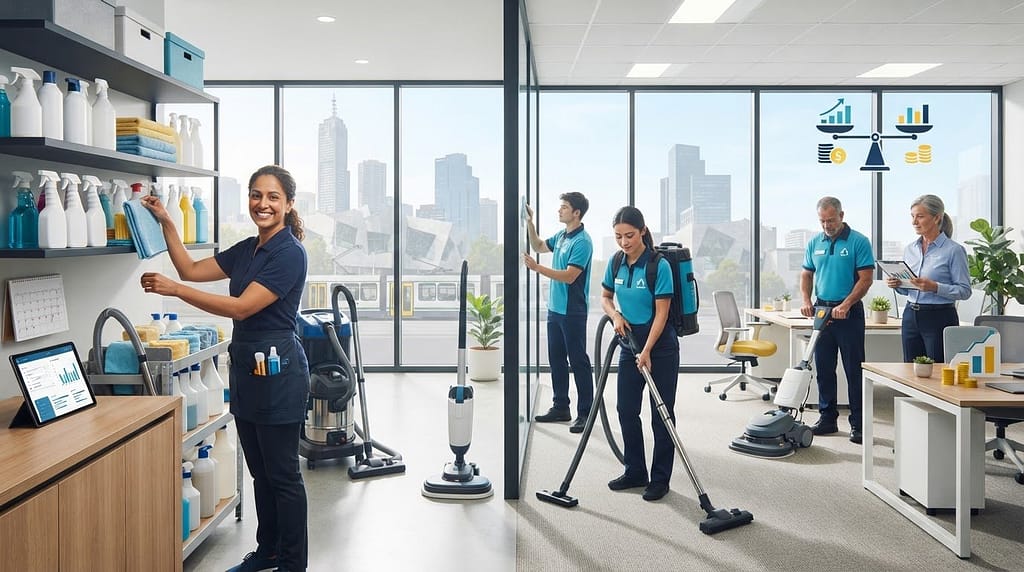
A lower hourly rate can hide a higher total cost. An in-house cleaners vs outsourcing cost analysis needs to look beyond wages and compare the full cost of delivering a clean, reliable workplace.
It’s natural to focus first on what an in-house cleaner earns or what an outsourced service costs. But direct employment can also involve superannuation, leave, recruitment, training, equipment and the time needed to manage rosters and cover absences. Outsourcing shifts some of these responsibilities to a cleaning provider, but it isn’t automatically the right fit for every site.
This guide shows Melbourne businesses how to compare like-for-like costs, identify who is responsible for each task and assess service quality and staff coverage. Your site, cleaning scope and schedule all affect the decision. Tidy Masters provides commercial cleaning across Melbourne, with services tailored to different workplaces. The aim is to help you choose a cleaning model that fits your operations, not just the headline rate.
Key Takeaways
- Make an in-house cleaners vs outsourcing cost analysis by comparing the same cleaning scope, frequency and quality expectations.
- Build a complete cost picture by listing employment, equipment and management expenses alongside the outsourced service scope.
- Look beyond the invoice: compare oversight, absence cover, flexibility and accountability for delivery.
- Use your site type, operating hours, cleaning schedule and internal capacity to guide the decision.
- A clearly defined scope helps Melbourne businesses assess whether outsourced cleaning suits their workplace and day-to-day needs.
In-House Cleaners vs Outsourcing: What Is Actually Being Compared?
Before comparing figures, define each arrangement. In-house cleaning means your business directly employs cleaners and organises their work. Outsourcing means engaging an external cleaning provider to deliver an agreed service. The difference is not only who performs the tasks. It also affects who manages staffing, equipment, coordination and service continuity.
A useful in-house cleaners vs outsourcing cost analysis compares equivalent requirements: the same site, cleaning frequency, task list and quality expectations. For example, comparing daily cleaning of shared areas with a provider’s weekly general clean won’t show which model offers better value. Define the required standard for your workplace and list high-use spaces and periodic tasks so both estimates cover the same work.
Total cleaning cost combines labour, management, supplies and service continuity. A wage figure alone leaves out time spent recruiting, rostering and supervising, as well as products, equipment and absence cover. An outsourced invoice also needs context: the agreed scope determines which tasks it covers and what responsibilities remain with your business. The broader meaning of Understanding Outsourcing: Definition and Motivations helps explain why organisations engage external specialists, including to focus internal effort on core operations.
What does an in-house cleaning arrangement involve?
With direct employment, your business recruits cleaners, sets rosters, supervises work and coordinates daily priorities. It also arranges products and equipment, including storage, replenishment, maintenance and replacement. These tasks take internal time, even when cleaning is only one part of a manager’s role.
Separate routine duties, such as cleaning common areas, from specialist or periodic work, such as window cleaning or hard-floor treatment. An employee’s everyday role may not cover every occasional task the site needs. Listing all requirements prevents those tasks from being overlooked in the comparison.
What does outsourced commercial cleaning involve?
With outsourcing, your business engages an external provider to deliver cleaning against an agreed scope. The schedule, site requirements and task expectations shape the service. A clear scope distinguishes regular upkeep from periodic or specialist work and identifies the areas that need attention at each visit. This gives both sides a shared reference for delivery.
Your business still sets requirements and communicates site-specific priorities, while the provider manages delivery of the agreed cleaning service. The right scope will differ between a Melbourne office, clinic, school, aged care facility or warehouse. For wider context on service types and common cleaning considerations, a commercial cleaning FAQ guide can help frame the questions to consider.
Start with the work your site needs, then compare who is responsible for delivering it and maintaining consistency. That makes the next step, calculating the full cost of each model, more meaningful.
How to Calculate the Full Cost of In-House Cleaning vs Outsourcing
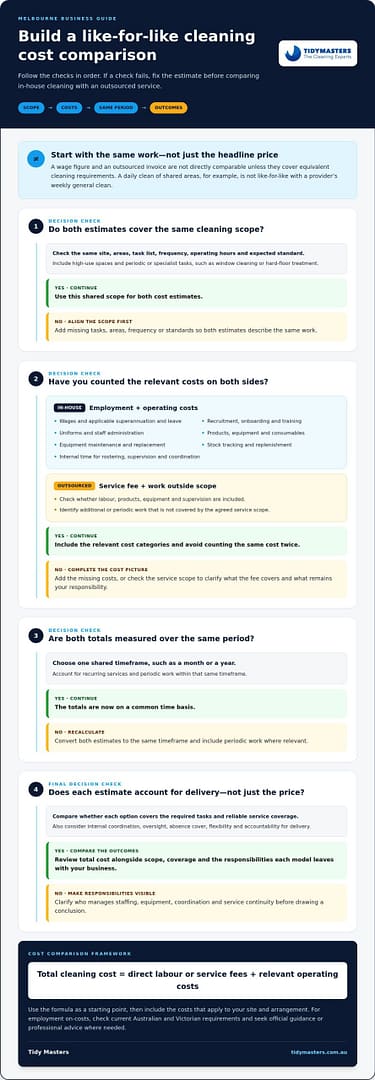
A reliable comparison needs more than an employee’s wage or a service provider’s invoice. Build both estimates around the same cleaning requirements, then include the costs and responsibilities needed to deliver them consistently. This gives your business a practical in-house cleaners vs outsourcing cost analysis without assuming either model will always be cheaper.
- Define the scope. Record the site areas, tasks, cleaning frequency, operating hours and expected standard.
- List each cost category. Include relevant employment and operating costs for an internal team, or service fees and any work outside the outsourced scope.
- Use the same period. Compare both options over the same timeframe, such as a month or year, and account for recurring and periodic work.
- Compare the outcomes. Check whether each estimate covers the required tasks and reliable coverage, and account for the internal coordination involved.
As a cross-check, Performing a Comprehensive Cost Analysis for Outsourcing explains why comparing an existing internal budget with an external quote alone can miss costs that change under outsourcing.
Total cleaning cost = direct labour or service fees + relevant operating costs. Use this as a starting point, then include the costs that apply to your situation. For employment on-costs, verify current Australian and Victorian requirements before entering figures. Check applicable award conditions, superannuation, leave, insurance and any payroll tax obligations against current official guidance or professional advice.
Which costs belong in an in-house cleaning calculation?
Start with wages and applicable employment obligations, including superannuation and leave. Add recruitment, onboarding, uniforms, training and staff administration where relevant. Estimate the products, equipment and consumables needed for the defined tasks, along with equipment maintenance and the time spent tracking and replenishing stock. Include management time for rostering and supervision, but don’t count the same cost twice if it is already included elsewhere.
How should businesses compare an outsourced service cost?
Assess the service fee against an equivalent scope, frequency, operating hours and service period. Read the agreed scope to establish whether labour, products, equipment and supervision are included. Separate routine tasks from additional or periodic work, such as a separately scheduled floor treatment, so neither estimate leaves out work the site needs. Record exclusions and compare the full set of required services, not just the invoice total.
A simple worksheet makes assumptions visible: list each task, who supplies the materials, how often the task occurs and which model carries the responsibility. That clarity supports a fair decision and a tailored service scope. For Melbourne businesses assessing outsourced commercial cleaning, Tidy Masters’ commercial cleaning services provide a practical reference for matching cleaning requirements to a defined service.
Where In-House and Outsourced Cleaning Differ Beyond the Invoice
The service fee is only part of the decision. In-house cleaning gives your business direct oversight of employees, but staffing and daily coordination remain internal tasks. Outsourcing can shift more of that coordination to a provider, while making a clear scope and good communication essential. Neither model is automatically cheaper or more consistent. The right fit depends on your site, operating requirements and capacity to manage cleaning.
| Consideration | In-house team | Outsourced provider |
|---|---|---|
| Control | Managers can give direct day-to-day instructions and adjust priorities. | Work is guided by agreed tasks, schedules and communication processes. |
| Administration | The business manages recruitment, rostering, supervision and staff coordination. | Some cleaning coordination shifts to the provider, while the business manages the service relationship and shares site information. |
| Coverage | The business arranges cover when an employee is absent or unavailable. | Coverage arrangements depend on the agreed service scope and provider processes. |
| Equipment | The business sources, stores, maintains and replenishes products and equipment. | Responsibility depends on what the agreed scope includes. |
| Flexibility | Managers can redirect work, subject to staffing and operational capacity. | Changes are managed through communication and any agreed adjustments to the service. |
| Accountability | Internal managers oversee tasks and address performance directly. | The provider is accountable for delivering the agreed work, while the business communicates site needs and feedback. |
Control, supervision and service consistency
Direct supervision can suit a workplace where priorities change during the day or cleaning needs frequent coordination with other staff. That control also creates an internal management task: someone must set priorities, monitor completion and follow up on missed work. Outsourcing replaces direct employee supervision with oversight of the agreed service and communication with the provider.
A written task schedule makes either arrangement easier to assess. Specify areas, tasks and frequency, then agree how completion and concerns will be communicated. This distinguishes managerial control, or the ability to direct how work is organised, from accountability for completing the agreed cleaning tasks.
Staff coverage, equipment and flexibility
Absences and schedule changes require a response under both models. With an in-house team, the business organises cover. With an outsourced arrangement, responsibilities depend on the agreed service. Equipment arrangements also vary, so specify who supplies and maintains tools and products, and where they’re stored.
Operating hours and site access matter for Melbourne workplaces. A clinic, school, warehouse or office may have different access windows, security procedures and busy periods. These requirements can affect which model is practical and how a service should be scheduled. Compare them alongside administration and service expectations, rather than treating the invoice as the whole answer.
A Melbourne Business Checklist for Choosing the Right Cleaning Model
The best fit depends on how cleaning works across your site, not just the number of areas to clean. Use this checklist to connect your workplace’s daily demands with the capacity available to manage them. The same in-house cleaners vs outsourcing cost analysis can lead to different decisions for a compact office, a busy clinic or a large warehouse.
- Site size and layout: Note the areas in scope, how they’re used and whether work is concentrated in one location or spread across a larger facility.
- Task frequency: Separate daily upkeep from weekly, periodic or specialist tasks. Consider whether priorities change during busy and quiet periods.
- Operating hours and access: Identify when cleaning can take place, access procedures and any areas that must remain available to staff, students, customers or patients.
- Internal capacity: Decide who would manage recruitment, rosters, supplies, performance and cover if cleaning were handled in-house.
- Specialist requirements: Consider the distinct cleaning needs of offices, clinics, schools, aged care facilities and warehouses, including tasks that call for a tailored schedule.
- Employment obligations: If considering direct employment, verify current Australian and Victorian requirements for wages, leave, superannuation, insurance and payroll before estimating the full commitment.
For an office, map cleaning tasks to how staff use meeting rooms, kitchens, amenities and shared spaces. Clinic managers may need to define different tasks and schedules for treatment rooms and public areas. A medical centre cleaning guide can help frame site-specific considerations, while a structured office cleaning plan can clarify everyday workplace priorities.
When might an in-house team suit your workplace?
Direct employment may suit a business that needs close daily control over changing cleaning priorities and has the management capacity to support it. Assess whether someone can consistently handle recruitment, rostering, products and equipment, supervision and performance follow-up. A stable site with a predictable schedule can be easier to staff directly, provided internal resources are available to manage the work.
When might outsourcing suit your workplace?
Outsourcing may suit a business that wants cleaning coordinated against an agreed scope, particularly when the site has distinct tasks or scheduling needs. A clinic, school, aged care facility or warehouse may need a service plan shaped around its spaces and operations. Your business still communicates access requirements and priorities, while the provider delivers the defined cleaning work.
Use the checklist to identify what matters most to your workplace: direct daily oversight, less internal coordination, or a service scope tailored to the site. The decision doesn’t need to be all-or-nothing. Some businesses keep particular tasks in-house and outsource other defined cleaning requirements. A clear scope makes responsibilities and expectations easier to manage.
For a Melbourne workplace considering outsourced commercial cleaning, discuss a cleaning scope tailored to your site with Tidy Masters, a local commercial cleaning provider operating since 2009.
Outsourced Cleaning in Melbourne: A Practical Next Step with Tidy Masters
A useful comparison ends with a clear picture of the work your site needs and the responsibilities your business can manage. Set out the cleaning tasks, frequency, operating requirements and any specialist needs. Then weigh the internal effort involved in staffing, supplies and oversight against a defined outsourced service scope. Don’t assume one model will always cost less. Focus on which arrangement can meet your workplace’s requirements with clear responsibilities and reliable delivery.
Tidy Masters is a Melbourne-based commercial cleaning and property maintenance company operating since 2009. Its services cover offices, medical centres, schools, aged care facilities, gyms and warehouses across metropolitan Melbourne and Geelong. Each environment has different priorities, so a tailored scope helps clarify the work before you compare options.
What a tailored commercial cleaning scope should clarify
Start with the site: the areas to be cleaned, how frequently each task is required and any access or operating constraints. Separate routine cleaning from periodic work so regular duties and occasional tasks aren’t confused or overlooked. Clear expectations make it easier to see what the service covers and how it relates to the internal responsibilities your business would otherwise carry.
For example, an office may need regular attention to shared spaces and amenities, while a warehouse may have different floor areas and operational patterns. A clinic, school or aged care site may also have distinct cleaning priorities. A useful scope reflects the actual site rather than relying on a generic task list.
Compare your requirements with a Melbourne cleaning partner
Before deciding, bring your cost comparison and operational needs together. Review the labour and employment costs considered for an in-house team, including obligations verified against current Australian and Victorian requirements. Then compare them with the outsourced scope, noting which tasks, products, equipment and coordination it includes. Keep service expectations consistent so the options remain genuinely comparable.
- Site: Record the areas and any distinct requirements.
- Schedule: Note cleaning frequency and suitable operating windows.
- Tasks: Separate routine duties from periodic cleaning.
- Responsibilities: Identify who manages staffing, supplies and service communication under each model.
This gives decision-makers a practical basis for choosing a model that suits the workplace, rather than relying on a headline figure alone. Tidy Masters works with Melbourne businesses and organisations in Geelong to shape commercial cleaning around different sites and operational requirements.
To explore a tailored option for your workplace, explore Tidy Masters’ commercial cleaning services.
Make Your Next Cleaning Decision with Confidence
Turn your comparison into a practical brief. Note the areas that need attention, the outcomes your workplace expects and the internal tasks you want to keep or hand over. This gives your decision an operational basis, not just a figure to compare. It also helps reveal whether your current arrangement still fits as your site, schedule or priorities change.
A sound in-house cleaners vs outsourcing cost analysis doesn’t need to lock you into one model forever. Review the decision when workplace needs shift, and use a clearly defined scope to keep responsibilities and service expectations visible. If outsourcing looks like a better fit, Tidy Masters can tailor commercial cleaning to your business requirements.
Explore tailored commercial cleaning for your Melbourne business and take the next step towards a workplace cleaning arrangement that works for you.
Frequently Asked Questions
Is outsourcing cleaning cheaper than employing an in-house cleaner?
Not always. The result depends on the cleaning workload, how often the site needs service and how much internal time employment requires. A useful in-house cleaners vs outsourcing cost analysis compares equivalent tasks and considers both direct spending and the effort of managing staff, supplies and absences. For a Melbourne workplace with changing needs, flexibility and clear accountability may matter as much as the final cost.
How much does it cost to hire an in-house cleaner versus outsourcing?
There’s no single figure that applies to every Melbourne business. In-house costs depend on hours, the applicable role and employment conditions, plus related operating expenses. Outsourced costs depend on the site and agreed cleaning scope. To compare them, estimate the same service period and list the same tasks for both options. Use current employment information for staffing estimates and a tailored service proposal for the outsourced comparison.
What costs should a business include when employing an in-house cleaner?
Include wages and applicable employment obligations, then account for the practical costs of maintaining the role. These may include recruitment, onboarding, uniforms, training, administration, cleaning products, equipment and upkeep. Also consider the manager’s time for rostering and performance oversight. For example, if a supervisor regularly orders supplies or arranges cover, include that work in the comparison rather than treating it as cost-free.
Can a Melbourne business use a hybrid in-house and outsourced cleaning model?
Yes. A business can divide cleaning responsibilities between its own staff and an external provider. For instance, employees might manage immediate workplace tidiness while a provider handles scheduled cleaning or a defined specialist task. The arrangement works best when responsibilities don’t overlap or leave gaps. Write down who handles each area, task and frequency, then compare the combined cost and coordination effort with a single-model option.
What happens to cleaning coverage when an in-house cleaner is absent?
With an in-house team, the business needs to decide whether another employee can cover the work, whether tasks can be deferred or whether additional staffing is needed. Set an absence plan before a gap occurs, including which tasks are essential and who approves changes. Coverage under an outsourced service depends on the agreed arrangements, so define how schedule changes and missed visits are communicated.
Who provides cleaning products and equipment under an outsourced arrangement?
That depends on the agreed scope. Some arrangements may include products, equipment and consumables; others may allocate particular items to the business. Make the division explicit before comparing costs. For example, note who supplies vacuum cleaners, chemicals and replacement stock, where items are stored, and who replenishes them. Clear ownership helps prevent duplicated purchases or essential supplies being unavailable when cleaning is scheduled.
How often should a business review its cleaning arrangement?
Review it when the workplace changes, not only when a budget is prepared. A move, renovation, change in occupancy, new operating hours or repeated feedback about missed tasks can mean the existing scope no longer fits. Melbourne businesses can also revisit the arrangement during planned budget reviews. Check whether task frequencies, internal coordination and service outcomes still match the site’s needs, then adjust the model or scope if required.