
In-House Cleaners vs Outsourcing: A Practical Cost Analysis for Melbourne Businesses
October 12, 2026
Epoxy Floor Cleaning and Maintenance: A Practical Guide
October 14, 2026
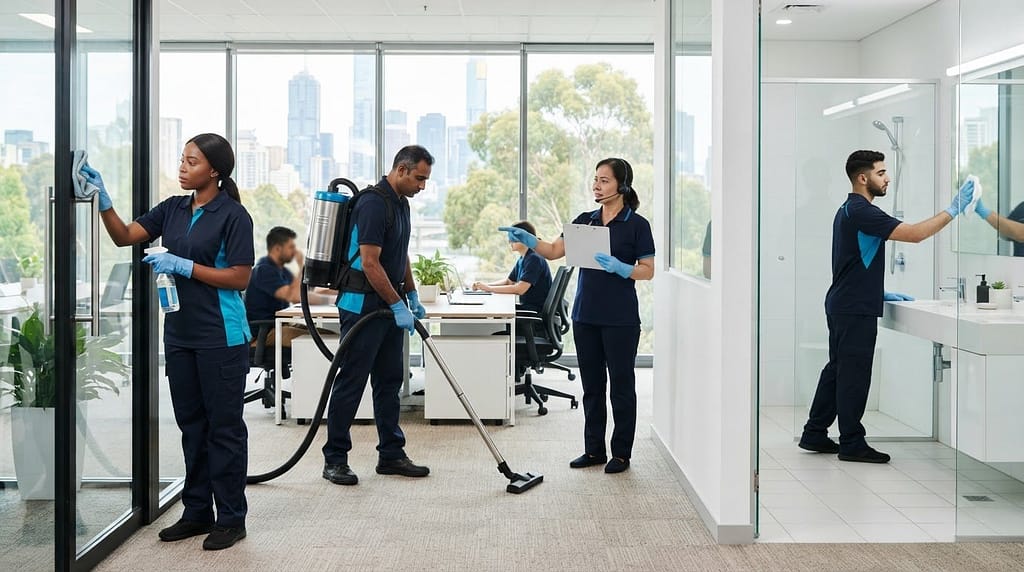
If you’re asking what is included in a commercial deep clean, the answer depends on the premises, the areas needing attention and the work agreed in the scope. A useful plan goes beyond routine upkeep without treating every facility the same. It identifies specific tasks and spaces, so you can see what the service is designed to cover.
Before arranging a clean, clarify which tasks are in scope, what needs separate planning and how the work can fit around staff and daily operations. A practical checklist helps you set priorities and avoid overlooking high-use areas.
This guide outlines common tasks such as dusting, surface wiping, disinfecting and bathroom sanitising, then shows how to adapt the list for your facility. You’ll also learn how an assessment and tailored plan can define the scope and document agreed work for your Melbourne workplace.
Key Takeaways
- Use the checklist to understand what is included in a commercial deep clean, while treating each task as part of an agreed scope rather than a universal package.
- Prioritise areas according to your facility’s needs, from shared touchpoints to sensitive work zones.
- Distinguish a focused deep-clean service from recurring cleaning by its purpose, planned tasks and reporting.
- Prepare by listing priorities, clarifying access and noting occupied areas or operating constraints.
- An assessment, tailored plan and reporting can make the cleaning scope clearer for your Melbourne workplace.
What Is Included in a Commercial Deep Clean? Start With This Checklist
A commercial deep clean is a planned service that targets agreed areas and tasks beyond routine upkeep. It isn’t a fixed package where every room receives the same treatment. The checklist should reflect how the site is used, which surfaces need attention and when cleaners can access the relevant areas.
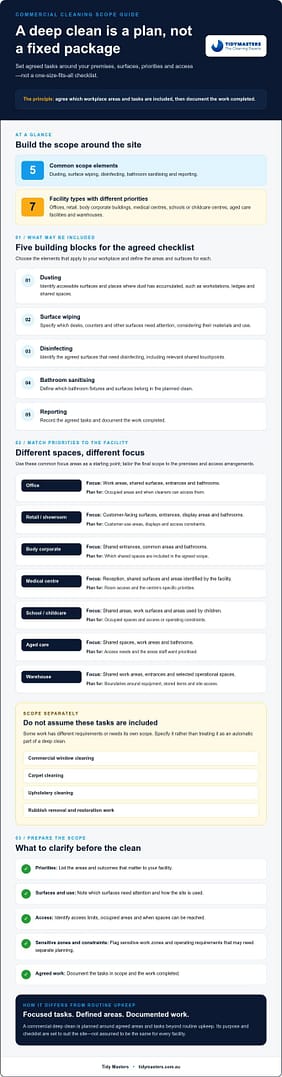
So, what is included in a commercial deep clean? Start with these common elements, then define which apply to your workplace:
- Dusting: Identify accessible surfaces and areas where dust has accumulated, such as workstations, ledges and shared spaces.
- Surface wiping: Specify which desks, counters and other surfaces need attention, taking their materials and use into account.
- Disinfecting: Identify the agreed surfaces that need disinfecting, including relevant shared touchpoints.
- Bathroom sanitising: Define which bathroom fixtures and surfaces are part of the planned clean.
- Reporting: Record the agreed tasks and document the work completed.
These modular elements can be combined to suit the premises. An assessment helps turn a broad request into a practical scope. It also helps identify access limits, sensitive work zones and tasks that need separate planning. For background on general cleaning practices, see the overview of common cleaning methods and their purposes.
Which areas belong on a commercial deep-clean checklist?
Group the checklist by how people use each area. Workstations may need attention to accessible desk surfaces. Shared areas can include counters and frequently handled points. Bathrooms need a defined sanitising scope, while overlooked touchpoints may include handles or switches. The assessment and tailored plan help determine which areas take priority, so the checklist reflects your premises rather than a generic template.
Checklist definition: A commercial deep clean is a planned service that targets agreed workplace areas and cleaning tasks beyond routine upkeep, based on site priorities, surface types and access.
What is not automatically part of every deep clean?
Some tasks need a separate scope. For example, Commercial Window Cleaning (Melbourne) may involve different access and work requirements from cleaning interior surfaces. Carpet cleaning and upholstery cleaning are specialised services, not automatic inclusions in a deep clean.
Rubbish removal and restoration work should also be specified rather than assumed. List the outcome you need and identify it as a distinct task. This keeps the scope clear and aligns the work with your site’s priorities.
How Commercial Deep-Clean Priorities Change by Facility
A deep-clean scope should reflect how each workplace is used. The priorities for a Melbourne office differ from those in a medical centre, childcare setting or warehouse. Use the comparisons below to identify areas for your plan, then tailor the final scope to the site’s needs and access arrangements.
| Facility | Likely focus areas | Scope-planning note |
|---|---|---|
| Office | Work areas, shared surfaces, entrances and bathrooms | Identify occupied areas and when cleaners can access them. |
| Retail store or showroom | Customer-facing surfaces, entrances, display areas and bathrooms | Prioritise areas customers use while accounting for displays and access constraints. |
| Body corporate building | Shared entrances, common areas and bathrooms | Clarify which shared spaces are included in the agreed scope. |
| Medical centre | Reception, shared surfaces and areas identified by the facility | Plan around room access and the centre’s specific priorities. |
| School or childcare centre | Shared areas, work surfaces and areas used by children | Identify occupied spaces and any access or operating constraints. |
| Aged care facility | Shared spaces, work areas and bathrooms | Discuss access needs and the areas the facility wants prioritised. |
| Warehouse | Shared work areas, entrances and selected operational spaces | Define boundaries around equipment, stored items and site access. |
Offices, retail stores and body corporate buildings
In an office, workstation areas and shared surfaces may be priorities. A retail store may need more attention on customer-facing areas and entrances, while a body corporate plan often centres on communal spaces. Occupancy patterns matter: a busy reception or shared kitchen may need different access arrangements from a seldom-used meeting room. Consider how professional office cleaning in Melbourne fits your workplace’s daily use, and use the Commercial Cleaning in Melbourne FAQ Guide for broader service context.
Medical centres, schools, aged care and warehouses
These settings need distinct plans, not a copied office checklist. A medical centre may prioritise particular rooms and shared areas identified by the facility. A school or childcare centre may need the plan to account for occupied spaces used by children. In aged care, note access needs and the areas staff want addressed. A warehouse scope should define boundaries around operational areas, equipment and stored goods. A site-specific plan helps make priorities clear without assuming one task list suits every facility.
To explore how facility-specific benchmarks can inform planning, consult the ISSA Clean Standard for commercial facilities. It offers a broader reference point; your agreed tasks should still reflect the premises and its needs. The Commercial Cleaning in Melbourne FAQ Guide also provides wider service context alongside this practical comparison.
Before planning, note occupied areas, sensitive work zones and access constraints. That information helps turn the question of what is included in a commercial deep clean into a relevant scope rather than a generic list. For a tailored Melbourne plan, explore Tidy Masters’ cleaning services.
Commercial Deep Clean vs Routine Cleaning: What Changes?
Routine commercial cleaning and a deep clean serve different planning purposes. Recurring work follows an ongoing plan to maintain the premises. A deep clean focuses on specific tasks or areas set out in an agreed scope. One doesn’t replace the other. A workplace may use both, depending on its needs.
Planned deep cleaning targets agreed tasks; routine cleaning follows a recurring maintenance plan. That distinction is more useful than assuming “deep clean” means one fixed list of tasks. The scope can change with the facility, surfaces, access and priorities.
How does a deep clean differ from regular commercial cleaning?
A recurring plan sets out the work carried out as part of ongoing upkeep. A focused deep-clean plan identifies particular areas or tasks for extra attention. “Scope” simply means the agreed list of work. Neither label determines the quality of the service; each describes a different way to organise cleaning around the site.
| Planning point | Routine commercial cleaning | Commercial deep clean |
|---|---|---|
| Purpose | Support ongoing workplace upkeep. | Address agreed priorities through a focused service. |
| Task focus | Follow recurring tasks set for the premises. | Direct attention to selected areas or tasks identified for the clean. |
| Planning | Use a continuing plan suited to the site. | Assess the premises and tailor the scope to current needs. |
| Reporting | May document work under the service plan. | Can record the tasks agreed and completed. |
There’s no universal deep-clean checklist or fixed scope. One workplace might prioritise shared surfaces; another may need a particular area addressed. If you’re asking what is included in a commercial deep clean, start by defining the purpose: which areas need attention, what tasks matter there and when access is practical. Those answers shape a useful scope without suggesting routine cleaning is inadequate.
When might a business consider a one-off deep clean?
A one-off deep clean may suit a change in site priorities, a planned focus on selected areas or a need to organise specific tasks separately from recurring upkeep. Use these as planning prompts, not as a promise of a particular result. Listing the areas and desired tasks helps clarify whether a focused service suits the workplace.
Some needs call for a distinct cleaning method rather than a broader deep-clean scope. For example, Steam Cleaning is a separate service to consider when the work calls for steam treatment. Keep that requirement distinct in the plan so it’s clear which tasks belong to the one-off deep clean and which require a separate service.
Once the purpose is clear, prepare the site information that will shape a workable plan. This makes the difference between routine upkeep and a focused service easier to communicate and document.
How to Prepare a Workplace for a Commercial Deep Clean
A little preparation helps turn a broad cleaning request into a workable plan. It also gives the cleaning team a clearer picture of the site while staff and business activities continue. Use this sequence to organise the details before agreeing on the scope.
- Identify priorities. List the areas that need focused attention and the tasks you want considered. Note why each area matters, such as frequent use, visible build-up or a change in site needs.
- Clarify access. Record operating hours, entry points, occupied areas and any spaces that require permission or an escort. Flag sensitive work zones and areas with restricted access.
- Align the plan. Share your priorities and constraints so the agreed scope reflects the property and how it is used. Confirm which tasks and areas are included, and how completed work will be documented.
What information helps shape the cleaning plan?
Start with the facility type, the areas you want prioritised and any relevant access arrangements. Identify surfaces or spaces that need particular attention, along with items or zones that should be treated carefully. These details make the scope specific rather than relying on a generic checklist. Tidy Masters assesses properties and tailors cleaning plans to their needs.
For example, a site contact might identify a busy shared area, note that one work zone stays occupied and specify which surfaces should be prioritised. That gives the plan useful context without assuming every part of the premises needs the same work. It also helps clarify what is included in a commercial deep clean for your workplace.
How can businesses plan around staff and site access?
Share your workplace hours, how cleaners can enter and which areas have access restrictions. Note when staff or visitors use particular spaces, and flag operating constraints that could affect the sequence of work. Tidy Masters offers flexible scheduling to help businesses plan cleaning around their operations. Discuss the schedule as part of planning, taking account of the agreed work and practical site access.
Keep the preparation checklist concise and practical:
- Priority areas and tasks to include in the scope
- Occupied areas and sensitive work zones
- Operating hours, entry points and access arrangements
- Surfaces needing particular attention
- Site constraints that could affect the cleaning plan
- Reporting needs for documenting agreed work
Share this information with the person coordinating the clean, then use it to align the scope before work begins. A clear plan helps staff understand which areas are involved and what access arrangements are needed. For a tailored commercial deep-clean plan in Melbourne, request a free quote from Tidy Masters.
How Tidy Masters Plans a Commercial Deep Clean in Melbourne
A clear process turns a general cleaning request into a scope that fits the premises. Tidy Masters assesses the site, builds a tailored plan around its priorities, completes the agreed tasks and uses reporting to document the work. This approach keeps the checklist relevant rather than treating every workplace as if it needs the same package.
From assessment to a tailored cleaning plan
The assessment identifies which areas and tasks matter to your workplace. Sharing the facility type, priority spaces, access arrangements and surfaces needing attention helps shape the plan. The agreed scope then sets out which tasks are included, so expectations are clear before cleaning begins.
Tidy Masters’ modular approach can include dusting, disinfecting, surface wiping and bathroom sanitising, selected to suit the property and its needs. These are adaptable package elements, not a fixed list applied to every site. Tidy Masters uses non-toxic, environment-friendly cleaning products. Quality audits and reports support documentation of the agreed work.
In practical terms, the process connects assessment to a tailored plan, a defined set of tasks and reporting. Modular elements such as dusting, disinfecting, surface wiping and bathroom sanitising can be matched to the workplace. That gives decision-makers a clearer basis for understanding what is included in a commercial deep clean and which tasks are part of their agreed scope.
Before the plan is finalised, consider whether your priorities are concentrated in particular areas or spread across the premises. Note access limits and operating constraints too. These details help the cleaning plan reflect how the site is used and provide a useful record of the work to be completed. Tidy Masters has provided cleaning services since 2009.
Request a free quote for your Melbourne premises
Once you’ve outlined the facility’s priorities, Tidy Masters can use that information to prepare a tailored plan for your Melbourne premises. A free quote is available, so you can describe the areas and tasks you want considered rather than settling for a generic scope.
Share the site details that will help shape the assessment, including priority areas, relevant surfaces and access arrangements. The resulting plan can organise the agreed work around your premises and its needs. Request a free commercial cleaning quote to discuss a tailored deep-clean plan for your Melbourne workplace.
Turn Your Checklist Into a Clear Cleaning Plan
A checklist is most useful when it helps your team make a decision. Before planning a clean, choose the areas that matter most and note any access or operating constraints that could shape the work. This gives you a practical starting point for defining what is included in a commercial deep clean at your premises.
You don’t need to settle every detail alone. Use your priorities to guide a tailored scope, then align the agreed tasks with how your workplace runs. A clear plan makes it easier to brief staff, prepare the site and understand what the service is designed to cover.
For Melbourne businesses, share your workplace requirements and explore a suitable cleaning plan with Tidy Masters. Request a free commercial cleaning quote to discuss your premises and priorities. A considered plan can make the process straightforward, so you can move ahead with confidence.
Frequently Asked Questions
How often should a business arrange a commercial deep clean?
There’s no single schedule that suits every workplace. The right timing depends on the facility, how its spaces are used and the priorities in its cleaning plan. A change in how a room is used, for example, may prompt a review of its cleaning needs. Reassess the premises when operations or priorities shift. Tidy Masters tailors cleaning plans for Melbourne commercial properties.
How long does a commercial deep clean take?
The time required depends on the premises, the areas in scope, access arrangements and the agreed tasks. A single estimate wouldn’t reliably fit every business. To help plan the work, describe the size and use of the areas you want cleaned, along with any access constraints, when requesting a free quote. Tidy Masters offers flexible scheduling for commercial cleaning, with the schedule planned around the property and agreed scope.
Can a commercial deep clean be scheduled around business operations?
Yes. Scheduling can be tailored to the property and its operating needs. Share the hours when areas are occupied, the available access points and any restricted spaces during planning. For example, note whether a reception area remains in use or access to certain rooms is controlled. Tidy Masters offers flexible scheduling, and the final arrangement should reflect the agreed work and practical site access.
Does a commercial deep clean include End-of-Lease Cleaning?
End-of-Lease Cleaning is a separate service, not an automatic part of every commercial deep clean. The right plan depends on the property and the purpose of the work. If you’re preparing commercial premises for a lease handover, describe the situation and the areas needing attention when requesting a free quote. This helps define the service context and relevant tasks without assuming the two scopes are interchangeable.
Does Tidy Masters provide commercial deep cleaning across Melbourne?
Tidy Masters serves the Melbourne metropolitan area and is based in Albert Park. Listed Melbourne suburbs include Hawthorn, Port Melbourne, Richmond, South Bank, South Yarra, St Kilda and Yarraville. Include your property location when requesting a free quote. Sharing the location alongside your cleaning priorities helps the team understand the site and tailor the plan.
How can I get a quote for a commercial deep clean?
Tidy Masters provides a free quote. Describe the facility, the rooms or areas you want prioritised, and any access or scheduling needs. You might also mention a specific surface or space that requires attention. These details give the team a clear starting point for a tailored plan for your Melbourne premises. Request a free quote to discuss the work suited to your site.