
Melbourne Commercial Disinfection: 2026 Business Guide
October 10, 2026
In-House Cleaners vs Outsourcing: A Practical Cost Analysis for Melbourne Businesses
October 12, 2026
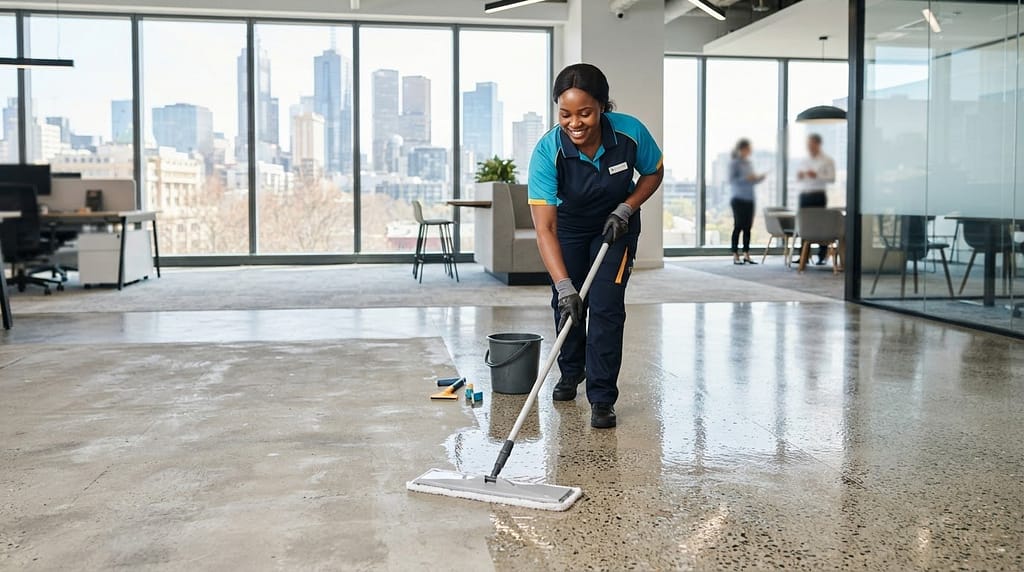
The newest floor coating isn’t automatically the right fix. If you’re searching for commercial floor sealing melbourne, start with a more useful question: what does the existing surface need, and how will the work fit around your business? One floor may need stripping and resealing, while another may need a different treatment. Choosing based on trends alone can lead to the wrong plan.
It’s understandable to want a clean, professional finish without disrupting staff, customers or daily operations. It can also be difficult to tell what preparation a floor needs and how to care for it afterwards. The right approach depends on the surface and the way your premises operate.
This guide explains what commercial floor sealing involves, how it differs from a coating, and what to consider when planning the work in Melbourne. You’ll learn how stripping and sealing fit into hard-floor maintenance, what preparation and aftercare can involve, and how to organise the job around business activity. Tidy Masters provides hard-floor stripping and sealing for commercial premises across Melbourne, with the work tailored to each site’s floors and operating needs.
Key Takeaways
- Match the treatment to the existing floor’s material, condition and finish rather than choosing a coating based on trends alone.
- Understand how commercial floor sealing melbourne can support hard-floor maintenance and when stripping and sealing may suit an existing surface.
- Compare stripping and sealing with epoxy coating by purpose and project context before choosing an approach.
- Plan access, furniture moves, foot traffic and communication with site users to help manage disruption during the work.
- Preparation and settling requirements vary, so schedule around the specific floor and treatment rather than assuming a fixed reopening time.
What commercial floor sealing in Melbourne does for your business
Commercial hard-floor stripping and sealing is a maintenance process for suitable existing floors. If an old finish needs to be removed, stripping prepares the surface before a new protective finish is applied. The aim is to refresh and maintain the floor, not automatically replace it or install a new flooring system.
Floor sealing maintains a suitable existing hard floor with a protective finish. Floor coating can refer to a separate system applied to create a new surface layer. The terms aren’t interchangeable, and a sealing service doesn’t automatically involve epoxy. The floor’s construction, current condition and existing finish all matter. A general overview of types of flooring can help explain why surfaces differ, but the appropriate maintenance approach depends on the floor at your premises.
A well-maintained floor can contribute to a clean, presentable commercial environment. It supports the impression customers form when they enter a retail space and helps shared areas look cared for. It also gives facility teams a defined maintenance task to plan, rather than relying on routine cleaning alone to address a worn or tired finish. Commercial floor sealing melbourne services should be considered in the context of the existing floor and the way the site is used.
What happens during hard-floor stripping and sealing?
Stripping is a preparation step, not an automatic requirement for every job. If an existing finish needs to be removed, stripping clears it from the floor so the surface can be prepared for the next treatment. Sealing follows, with a protective finish suited to the prepared surface. The preparation and treatment are tailored to the floor’s condition and existing finish, rather than assumed from the building type alone.
This distinction helps set realistic expectations. Stripping and sealing maintains a suitable existing hard floor. It doesn’t mean the floor is being rebuilt or covered with an epoxy coating. Assessment comes first, so the work addresses what the surface actually needs.
Which commercial spaces may benefit from floor maintenance?
Offices, retail premises and shared commercial areas can all have hard floors that need planned attention. Entry points, corridors and common rooms may experience regular foot traffic, while back-of-house areas can have different patterns of use. Traffic levels and visible floor condition help determine when maintenance may be appropriate. A busy walkway and a lightly used room shouldn’t automatically be treated as though they have identical needs.
For a Melbourne workplace, consider where people walk most, how the finish looks across the site and whether routine cleaning is enough to keep the floor presentable. Floor care is also part of a broader facility plan. The commercial cleaning guide provides wider context for coordinating cleaning across business premises, while hard-floor stripping and sealing addresses the needs of suitable existing floors.
How Melbourne floor stripping and sealing is planned for existing surfaces
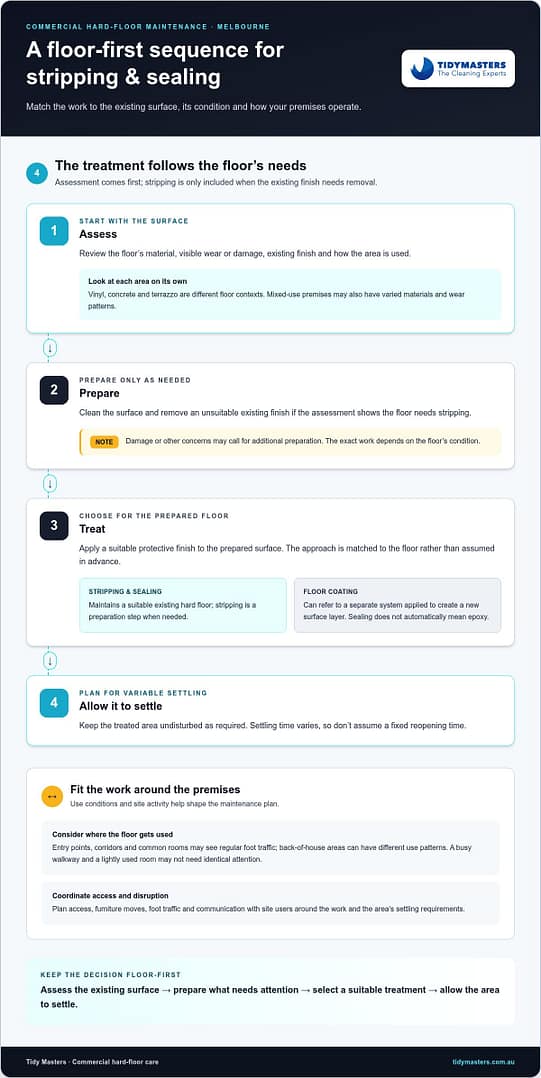
Assess the floor before choosing a treatment. Its material, condition and existing finish determine what preparation is appropriate. This first step helps distinguish routine maintenance of a suitable hard floor from work that needs a different approach. When planning commercial floor sealing melbourne, match the process to the surface and premises instead of applying the same method everywhere.
A practical plan follows a clear sequence:
- Assess: Review the floor’s material, visible wear, damage and existing finish, along with how the area is used.
- Prepare: Clean the surface and remove an unsuitable existing finish if the floor requires stripping. Further preparation depends on what the assessment reveals.
- Treat: Apply a suitable finish to the prepared surface, matching the approach to the floor rather than assuming it in advance.
- Allow it to settle: Keep the treated area undisturbed as required. Settling time varies, so don’t plan around an assumed fixed reopening time.
Why floor material and condition matter
Vinyl, concrete and terrazzo are examples of different floor contexts, not interchangeable surfaces. Their construction and existing finishes can affect which preparation and treatment are appropriate. Wear, damage, residue or layers of old finish may also change the plan. A surface in sound condition may need a different response from one with visible deterioration, so don’t assume one process or sealer will suit every floor.
This matters in mixed-use premises, where adjoining areas may have different floor materials or wear patterns. Assessing each area helps avoid treating the whole site as though it were one uniform surface.
What preparation can involve
Preparation may include cleaning and removing an existing finish that isn’t suitable to remain beneath the new treatment. If the surface shows damage or other concerns, additional preparation may be needed before sealing. The exact work depends on the floor’s condition, so identify those needs before setting expectations about method or timing.
Maintenance sealing should also be distinguished from preparing concrete for a coating system. Grinding or repairing concrete may form part of a separate project to create a suitable base for a new coating. That isn’t automatically the same as stripping and sealing an existing hard floor. The right plan depends on whether the goal is to maintain the current surface or prepare it for a different system.
For commercial premises across Melbourne, Tidy Masters provides hard-floor stripping and sealing tailored to each site’s needs. If your existing floor needs a considered maintenance plan, explore Tidy Masters hard-floor stripping and sealing as part of your property-maintenance approach.
Commercial floor sealing or epoxy coating: which approach fits?
These terms describe different types of work. Stripping and sealing is maintenance for a suitable existing hard floor. An epoxy coating is a distinct flooring system. The right choice depends on the floor’s condition and the site’s needs, not on which option looks more industrial or substantial.
Use this comparison as a starting point for assessment, not as a substitute for inspecting the actual surface.
| Consideration | Stripping and sealing | Epoxy coating |
|---|---|---|
| Purpose | Maintain a suitable existing hard floor by preparing it and applying an appropriate finish. | Create a distinct coating system over a prepared surface. |
| Typical project context | An existing floor’s finish or presentation needs attention. | The project calls for a new coating system, with its own preparation and selection process. |
| Assessment questions | What is the floor made of? What condition is it in? Does the existing finish need removal? | What surface will receive the coating? What preparation and system suit the site’s requirements? |
“More industrial” doesn’t automatically mean “more suitable”. A business may see epoxy used in a warehouse or commercial space and assume it’s the upgrade every hard floor needs. But the setting or visual style alone can’t determine the right treatment. If the existing floor is suitable for maintenance, stripping and sealing may be the relevant scope. If the project calls for a different surface system, that’s a separate decision.
When maintenance sealing may be the relevant conversation
Consider maintenance sealing when the finish or appearance of an existing hard floor needs attention and the goal is to maintain that surface. The assessment should establish the material, its current condition and whether the existing finish needs stripping. Those details matter because a process that suits one floor shouldn’t be assumed to suit another. The purpose is to match the maintenance work to the floor, not to promise a particular performance or lifespan.
When a coating system is a different scope
A coating project can involve a different level of preparation and a decision about the system itself. Epoxy resin is one example of a coating category. It isn’t another name for a floor seal. The assessment needs to consider the existing surface and what the premises require from a new system. This keeps the conversation focused on the project’s actual scope, rather than treating every tired-looking floor as a coating job.
For commercial floor sealing melbourne, start by clarifying the goal: maintain a suitable existing hard floor or develop a plan for a distinct coating system. Surface condition and site requirements should guide that choice. Tidy Masters provides hard-floor stripping and sealing for commercial premises across Melbourne, with the work planned around each site’s floor and operating needs.
How to schedule commercial floor sealing around Melbourne operations
Floor work is easier to manage when the plan accounts for how people use the premises. In Melbourne offices, retail sites and shared commercial buildings, access needs can change throughout the day. Map busy routes, staff movements and customer areas before setting the work sequence. Where operations allow, schedule the affected area during a quieter period and plan an alternative route for people who still need to move through the site.
Use this checklist to prepare the area and keep communication clear:
- Define the work zone: Identify which rooms, corridors or access points will be affected, and decide how people can move around them.
- Coordinate furniture and equipment: Agree what needs to be moved and who will arrange it before work begins. Keep items that obstruct the floor or access route out of the planned area.
- Consider foot traffic: Note busy periods, deliveries, appointments and other regular activity that could cross the work zone.
- Inform site users: Tell staff, tenants or customers which areas will be affected, what access changes to expect and where to go instead.
Prepare the site and communicate with staff
A clear site plan helps prevent confusion on the day. For example, an office may need to direct staff away from a treated corridor, while a retail premises may need to make the affected section easy for customers to identify. Arrange furniture and equipment in advance instead of leaving decisions until the area is being prepared. Share access updates through the communication channels people at the site already use.
For larger or shared premises, make sure the people responsible for site access understand the plan and can pass it on consistently. A simple notice should identify the affected area and any temporary route changes. Keep the message practical, and update it if the work zone or access plan changes.
Plan access after the work
Don’t assume every treatment has the same settling or access requirements. Follow the instructions for the specific treatment and keep people off the treated area until the stated conditions are met. Avoid promising a fixed reopening time before those requirements are known. Build flexibility into the site plan, especially if the area is a main walkway or connects essential rooms.
Once access resumes, return furniture and equipment in line with the treatment instructions. Continue routine care in a way that suits the floor and the site’s use. A coordinated cleaning plan helps maintain workplace presentation between specialist floor-maintenance visits. For broader upkeep in an office setting, the Melbourne office cleaning guide covers ongoing workplace cleaning considerations.
Good scheduling comes down to a clearly defined work zone, prepared spaces and realistic access planning. For commercial floor sealing melbourne, Tidy Masters plans hard-floor stripping and sealing around your premises’ needs. Arrange commercial hard-floor stripping and sealing for your Melbourne site.
Arrange commercial hard-floor stripping and sealing with Tidy Masters
Tidy Masters is a Melbourne-based commercial cleaning and property-maintenance company. Hard-floor stripping and sealing is part of its service offering, supporting businesses that need specialist care for suitable existing floors. The work is planned around the site rather than treated as a one-size-fits-all task. Floor condition, areas in use and the way people move through the premises all inform a practical approach.
That site-specific focus matters because floor conditions can vary from one area of a building to another. A reception space, corridor or staff area may see different foot traffic and show different signs of wear. Sharing these details helps establish what the work needs to address and how to fit it into the wider maintenance plan.
A tailored approach to commercial hard floors
Tidy Masters considers the existing floor and the site’s operating requirements when planning hard-floor stripping and sealing. Preparation and treatment should respond to the surface’s observed condition rather than assume every floor needs the same process. This keeps the work focused on maintaining suitable existing hard floors while helping you plan around access and everyday business activity.
Floor maintenance can also sit alongside a broader commercial cleaning programme. Routine cleaning and specialist floor care have different roles, but coordinating them helps facility teams plan upkeep across the premises. If you’re considering commercial floor sealing melbourne for an office, retail space or another commercial site, a clear picture of the floor and its use is a useful starting point.
Take the next step for your Melbourne site
Before making an enquiry, gather a few practical details about the area. You don’t need a technical report. A straightforward description can help frame the discussion around the premises and the work involved.
- Approximate floor area: Note the size of the space or the specific sections that need attention.
- Surface type: Describe the floor material if you know it, and mention whether adjoining areas have different surfaces.
- Visible concerns: Point out worn-looking finishes, damage or other conditions you’ve noticed.
- Site operations: Explain how the space is used, when foot traffic is busiest and whether access needs to be planned around staff, tenants or customers.
These details help keep the conversation clear and relevant. Tidy Masters can discuss the commercial hard-floor stripping and sealing needs of your Melbourne premises with the existing surface and operating requirements in view. Share what you know about the floor so the discussion can start with your site’s needs.
For a considered maintenance plan, discuss commercial floor sealing with Tidy Masters. A clear description of your Melbourne premises is the first step towards planning the right work for its existing hard floors.
Make your next floor-care decision with confidence
Turn your floor concern into a clear brief. Note what you want the work to address, which areas matter most to daily operations and who should coordinate access on site. This gives the planning conversation a practical starting point and keeps the focus on your premises rather than a generic flooring solution.
If you’re considering commercial floor sealing melbourne, share what you know about the surface and the conditions affecting it. You don’t need to settle on a treatment before discussing the site. A considered conversation can help clarify the maintenance scope and how it may fit your business routine.
Discuss commercial floor sealing for your Melbourne site with Tidy Masters. A clear brief is a practical first step towards planning care for your commercial floors.
Frequently Asked Questions
Does commercial floor sealing make a floor waterproof?
No. Floor sealing shouldn’t be treated as waterproofing or as a way to stop water entering through joints, cracks or the floor structure. A finish may help protect a suitable surface during normal use, but its effect depends on the floor and treatment. If water ingress, persistent dampness or spills are a concern, identify the source and discuss the floor’s condition before deciding on maintenance.
Can floor sealing change how a commercial floor looks?
Yes, applying a new finish can affect a floor’s appearance. The change may be more noticeable if an old or uneven finish is removed first. The result depends on the existing surface and the finish selected, so don’t assume sealing will make every floor look identical or conceal damage. For a consistent appearance across adjoining areas, consider how differences in material, wear and existing finish may show.
Can a sealed commercial floor still become slippery?
Yes. A sealed floor can still become slippery, for example if water, grease, dust or cleaning residue is present. The finish alone doesn’t guarantee safe footing in every condition. Keep the area clean, address spills promptly and follow site procedures for warning people about wet floors. If staff report a change in traction, treat it as a concern to assess rather than assuming the seal prevents slipping.
How often should a business have its floors resealed?
There isn’t one resealing interval that suits every business. Foot traffic, the floor’s condition, cleaning practices and the existing finish all affect when maintenance may be needed. Rather than relying only on a calendar reminder, note changes such as uneven wear or a finish that no longer looks consistent after routine cleaning. A maintenance review can help determine whether resealing is appropriate for that area.
What should I do if an old floor finish is peeling?
Don’t apply a fresh finish over peeling areas. Loose material can leave an uneven surface and may continue to lift. Keep people clear of any section that could catch footwear, and avoid scraping or applying products until the floor has been assessed. Make a note of where the peeling occurs and whether it’s spreading. This helps guide the next step for the existing finish and surface.
Can commercial floor stripping and sealing be done outside business hours?
It can be scheduled outside business hours when the project plan and site access arrangements support that timing. The work area still needs to remain clear, and people must stay off the treated floor until the treatment-specific access conditions are met. For a Melbourne site, include opening hours, building access and essential staff movements in the plan. Don’t set a reopening time without accounting for the treatment requirements.